

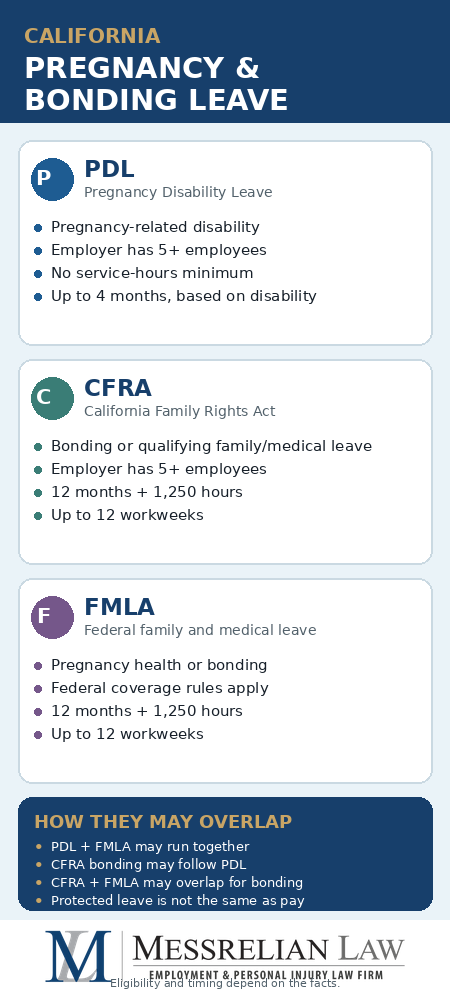
California employees may hear several different names when requesting leave during or after pregnancy: Pregnancy Disability Leave, the California Family Rights Act, and the federal Family and Medical Leave Act. These laws can overlap, but they are not interchangeable.
Pregnancy Disability Leave, often called PDL, applies when an employee is disabled by pregnancy, childbirth, or a related medical condition. CFRA can provide eligible employees with time for baby bonding and certain family or medical needs. FMLA may cover pregnancy disability, prenatal care, childbirth recovery, and bonding when both the employer and employee meet federal eligibility requirements.
The result depends on employer size, length of employment, hours worked, medical need, the reason for leave, and how earlier leave was counted. An employee should not assume that one approval determines every right or that a payroll benefit is the same as job-protected leave.
The Three Laws Serve Different Purposes
The simplest way to understand these protections is to separate pregnancy disability from family bonding.
| Law | General purpose | Basic eligibility | General amount |
| PDL | Leave for disability caused by pregnancy, childbirth, or a related medical condition | Employer with five or more employees; no minimum service time or hours worked | Up to four months per pregnancy, based on the actual period of disability |
| CFRA | Family and medical leave, including bonding with a new child | Employer with five or more employees; more than 12 months of service and 1,250 hours in the prior 12 months | Up to 12 workweeks in a 12-month period |
| FMLA | Pregnancy-related serious health conditions, birth, and bonding | Federal employer coverage plus 12 months of service and 1,250 hours; private-sector worksite rules also apply | Up to 12 workweeks in a 12-month period |
This table is only a starting point. Public employers, school employees, remote-work arrangements, prior leave use, and other facts can affect the analysis. The California Civil Rights Department’s PDL and bonding leave guide provides an official comparison.
California Pregnancy Disability Leave Covers the Period of Disability
PDL is tied to a healthcare provider’s determination that an employee is disabled by pregnancy, childbirth, or a related medical condition. It is not limited to the day of delivery or a fixed postpartum period.
Pregnancy disability may involve time away from work for severe morning sickness, prenatal or postnatal care, physician-ordered bed rest, childbirth, recovery, or another qualifying medical condition related to pregnancy. The duration should reflect the employee’s actual disability rather than a standard number assigned to everyone.
PDL applies to employers with five or more employees
California’s PDL protections generally apply to employers with five or more employees. Unlike CFRA and FMLA, PDL does not require the employee to complete a particular number of months or hours before becoming eligible.
A newly hired employee may therefore have PDL rights even if the employee has not worked long enough to qualify for CFRA or FMLA. Other requirements still apply, including that the employee be disabled by pregnancy, childbirth, or a related medical condition.
PDL can provide up to four months per pregnancy
An eligible employee may receive up to four months of PDL per pregnancy when medically disabled for that period. Four months is not an automatic entitlement to take regardless of medical need, and an employer should not impose a shorter universal recovery period that ignores the employee’s actual disability.
PDL can be taken all at once or, when medically needed, intermittently or on a reduced schedule. The amount available may be measured according to the employee’s regular work schedule.
Accommodation may be relevant before full leave
Pregnancy-related rights are not limited to complete absence from work. Depending on medical need and the circumstances, an employee may request a reasonable accommodation, such as modified duties, a changed schedule, more frequent breaks, or transfer to a less strenuous or hazardous position.
Whether a requested accommodation is reasonable and whether another effective option exists depends on the job, medical restrictions, and employer circumstances. The Civil Rights Department’s broader employment protections page explains state protections involving pregnancy and workplace discrimination.
CFRA May Provide Separate Baby-Bonding Leave
The California Family Rights Act applies to employers with five or more employees, but the employee must meet service and hours requirements. In general, an employee must have more than 12 months of service and at least 1,250 hours worked during the 12 months before leave begins.
Eligible employees may receive up to 12 workweeks of CFRA leave in a 12-month period for qualifying reasons. Those reasons include bonding with a new child after birth, adoption, or foster-care placement.
Pregnancy disability and CFRA bonding are separate
Pregnancy disability itself is treated differently under California law. PDL covers the period when the employee is medically disabled by pregnancy or childbirth. CFRA may then provide separate bonding leave if the employee is eligible and has CFRA time available.
This means an eligible employee may use PDL during pregnancy disability and later use CFRA for bonding rather than having the two state entitlements automatically run together. The exact sequence depends on medical certification, delivery and recovery dates, prior CFRA use, and the employer’s leave year.
Bonding leave generally must be completed within 12 months
CFRA baby-bonding leave generally must be taken within 12 months of the child’s birth, adoption, or foster-care placement. Rules can govern how bonding leave is divided into separate periods, although an employer may agree to a different arrangement.
CFRA is not reserved only for the employee who gave birth. An eligible parent may use it for bonding regardless of gender. The employee still must satisfy CFRA’s service and hours requirements.
FMLA Is the Federal Layer
FMLA is a federal law with a larger employer threshold than California PDL or CFRA. A covered private employer generally has at least 50 employees. For an individual employee to qualify, the employee generally must have worked for the employer for at least 12 months, completed at least 1,250 hours during the preceding 12 months, and worked at or reported to a location where the employer has at least 50 employees within 75 miles. Public agencies and educational employers have separate coverage rules.
Eligible employees can receive up to 12 workweeks of FMLA leave in a 12-month period for qualifying reasons. Pregnancy-related incapacity, prenatal care, childbirth recovery, and bonding with a newborn can qualify. The U.S. Department of Labor’s FMLA frequently asked questions explain the federal framework.
FMLA may run at the same time as PDL
When an employee is eligible for both FMLA and PDL, pregnancy-disability leave may count under both laws at the same time. For example, a medically required absence before or after childbirth may use available FMLA time while also using PDL.
That overlap can reduce the amount of FMLA remaining later in the employer’s 12-month leave period. It does not automatically reduce CFRA bonding leave, because California treats pregnancy disability and CFRA bonding separately.
FMLA and CFRA may run together for bonding
If an employee qualifies for both laws, FMLA and CFRA baby-bonding leave generally run concurrently. The employee does not necessarily receive 12 weeks under FMLA followed by another 12 weeks under CFRA for the same bonding period.
The interaction can be confusing when FMLA was already used during pregnancy disability. An accurate leave timeline should identify the reason for each absence, which law the employer designated, the employer’s method for measuring the leave year, and how much leave remained on each date.
Two Examples of How the Laws May Fit Together
Consider an employee who works for a large employer, meets the service and hours tests, and becomes medically unable to work late in pregnancy. The employee may use PDL during the medically certified disability period. Because the employee also qualifies for FMLA, the employer may count available FMLA at the same time. After the employee is no longer disabled, the employee may be eligible to use CFRA for baby bonding.
Now consider a recently hired employee at a company with ten employees. That worker may qualify for PDL because the employer has at least five employees and PDL has no minimum service or hours requirement. The employee may not yet qualify for CFRA because the service and hours tests have not been met. FMLA may not apply because of both employer-size and employee-eligibility requirements.
These examples illustrate possible frameworks, not conclusions for a particular worker. Prior leave, intermittent schedules, remote work, public employment, collective-bargaining terms, and company policies may change the analysis.
Job Protection and Pay Are Separate Questions
PDL, CFRA, and FMLA are generally unpaid leave laws. They may provide job protection and continuation of group health benefits when their requirements are met, but they do not necessarily replace wages.
An employee may separately qualify for accrued paid sick leave, vacation or other employer-provided paid time, California State Disability Insurance, California Paid Family Leave, employer short-term disability or parental-leave benefits, or benefits provided through a collective-bargaining agreement.
A wage-replacement program does not by itself create job protection. Conversely, an employee may have protected leave even when no wage-replacement benefit is available.
Employer rules can affect when accrued paid leave is used. Employees should keep copies of leave designations, benefit notices, payroll records, and communications explaining how each absence was coded.
Reinstatement and Health Benefits
PDL, CFRA, and FMLA each contain reinstatement and health-benefit protections, subject to their requirements and exceptions. Generally, an eligible employee returning from protected leave should be restored to the same or a comparable position, depending on the law involved.
The precise reinstatement analysis may involve whether the job would have existed even if leave had not been taken, whether the employee can perform essential duties with or without accommodation, and whether a statutory exception applies. Leave does not create greater job security than the employee would have had if continuously working, but an employer generally cannot use protected leave as a negative factor in an employment decision.
Group health coverage continuation rules also apply during qualifying leave. Employees should review written notices and ask for clarification if coverage dates are unclear.
Notice and Medical Certification
When the need for leave is foreseeable, an employee generally should provide at least 30 days’ notice when possible. If 30 days is not practicable, notice should be given as soon as practicable.
An employee does not always need to use the correct legal acronym. The communication should provide enough information for the employer to understand that the absence may involve pregnancy disability, a serious health condition, or bonding. Still, a written request can reduce disputes about when notice was provided and what was requested.
An employer may request an appropriate medical certification for pregnancy disability or another medical leave. The certification generally addresses the need, timing, expected duration, or work restrictions rather than requiring unnecessary details about the employee’s complete medical history.
Employees should keep the original leave request; medical certifications and work restrictions; employer approval, denial, or designation notices; attendance and payroll records; benefit notices; emails or messages about return-to-work dates; records of schedule or duty changes; notes of conversations about leave; and any discipline or adverse action occurring near the request.
Medical documents should be shared through the employer’s appropriate leave or human-resources process.
Interference, Retaliation, and Discrimination Are Different Concerns
A leave dispute may involve more than a disagreement over dates. Depending on the facts, an employer may unlawfully interfere with protected leave, retaliate because an employee requested or used leave, or discriminate based on pregnancy or a related medical condition.
Potential concerns include refusing to consider a qualifying request; discouraging an employee from taking protected leave; counting protected absences under a disciplinary attendance system; denying an appropriate return to work; cutting hours, duties, or opportunities because leave was used; making negative comments about pregnancy or bonding responsibilities; or terminating an employee shortly after a protected request without a supported, lawful reason.
Timing alone does not prove retaliation, and not every unfavorable action is unlawful. The decision-maker’s knowledge, stated reason, consistency with workplace policies, comparison evidence, and written records may all matter. Messrelian Law provides information about employee-side representation on its California employment law page.
Deadlines Can Differ by Claim
Employees should seek advice promptly rather than waiting for a general deadline. California Civil Rights Department employment complaints are generally filed within three years of the last alleged harm, but exceptions and different rules can apply. The CRD explains its process on the official employment complaint process page.
A federal FMLA lawsuit generally has a two-year limitations period, which may extend to three years for a willful violation. Determining accrual, willfulness, tolling, administrative requirements, and which legal theories apply requires a fact-specific analysis.
Other claims may have different deadlines. An internal human-resources complaint does not necessarily pause a government filing or lawsuit deadline.
Steps to Take When Leave Rights Are Unclear
- Build a leave timeline. Record each absence, its reason, and whether the employer identified PDL, CFRA, FMLA, paid leave, or another category.
- Check employer size and work location. The state and federal laws have different coverage thresholds, and FMLA uses a 50-employees-within-75-miles rule for many private-sector workers.
- Calculate service and hours carefully. PDL does not require a minimum period of employment, while CFRA and FMLA generally require 12 months and 1,250 hours.
- Separate disability from bonding. Identify when a healthcare provider considered the employee disabled and when leave was requested solely for bonding.
- Preserve documents. Keep policies, handbooks, pay records, certifications, leave notices, benefit information, and messages.
- Ask for the decision in writing. If leave is denied or counted in an unexpected way, request the reason and the employer’s calculation.
- Avoid removing confidential company material. Preserve records the employee may lawfully keep, but do not take privileged, proprietary, or unrelated personnel information.
- Get prompt advice. Deadlines, reinstatement rights, and available remedies depend on the facts and legal claims.
Discuss a Pregnancy-Leave Dispute With Messrelian Law
Pregnancy leave can involve several legal systems at once. A useful review should identify the employer, work location, service dates, hours, reason for leave, medical disability period, bonding request, prior leave use, employer designations, and any adverse action.
Request a free case evaluation with Messrelian Law to discuss a California pregnancy-leave, family-leave, accommodation, discrimination, or retaliation concern. Call (818) 484-6531 or complete the form on the evaluation page.
Frequently Asked Questions
- Is Pregnancy Disability Leave the same as maternity leave?
Not exactly. PDL is California job-protected leave for an employee who is disabled by pregnancy, childbirth, or a related medical condition. “Maternity leave” is an informal term that may refer to disability leave, baby-bonding leave, employer-paid parental leave, or a combination of programs. - Do I need to work for one year before qualifying for PDL?
No minimum service period or hours-worked requirement generally applies to California PDL. The employer generally must have at least five employees, and the employee must be disabled by pregnancy, childbirth, or a related medical condition. CFRA and FMLA have separate service and hours tests. - Can I take CFRA bonding leave after Pregnancy Disability Leave?
An eligible employee may generally use CFRA bonding leave after the employee’s PDL period ends. CFRA requires more than 12 months of service and at least 1,250 hours worked during the preceding 12 months. Prior CFRA use and the employer’s leave year can affect the amount remaining. - Does FMLA run at the same time as Pregnancy Disability Leave?
It can. If the employee and employer are covered by FMLA, medically required pregnancy-disability leave may count under both FMLA and PDL at the same time. The employer’s designation and the employee’s available FMLA balance should be reviewed. - Can both parents use CFRA for baby bonding?
Eligible parents may use CFRA for bonding regardless of gender. Each employee’s eligibility and available CFRA balance must be evaluated. When both parents work for the same employer, current state rules and the employer’s administration of leave should be checked rather than assuming their combined time is limited. - Are PDL, CFRA, and FMLA paid?
The laws are generally unpaid, but an employee may receive wage replacement through accrued paid leave, State Disability Insurance, Paid Family Leave, an employer program, or another benefit. Wage replacement and job protection are separate, so receiving one does not automatically establish the other. - How much notice must I give for pregnancy or bonding leave?
When leave is foreseeable, 30 days’ notice is generally expected when practicable. If the need arises sooner or 30 days is not possible, notice should be provided as soon as practicable. Emergencies, medical changes, and employer procedures can affect what is reasonable. - Can my employer ask for medical certification?
An employer may request appropriate certification supporting pregnancy disability or another medical leave. The certification may address restrictions, expected duration, and the need for leave. The employer is not automatically entitled to an employee’s entire medical history. - Can my employer fire me while I am on protected leave?
Protected leave generally cannot lawfully be used as the reason for termination or another adverse action. Leave does not prevent an employer from acting for a legitimate reason unrelated to the leave. Whether a termination was lawful depends on the evidence, timing, stated reason, and applicable protections. - How long do I have to challenge a pregnancy-leave violation?
The deadline depends on the claim. A California CRD employment complaint is generally due within three years of the alleged harm, while a federal FMLA lawsuit generally has a two-year period that may extend to three years for a willful violation. Exceptions and other claims may change the deadline, so prompt legal advice is important.