

 A missed break concern often begins with a simple pattern: lunch starts late, a supervisor calls during the break, the time system deducts 30 minutes even though work continued, or staffing makes rest periods unrealistic. California law sets meal and rest period rules for many nonexempt employees, but whether a violation occurred depends on the worker’s classification, the applicable wage order and what actually happened. A useful record should show more than a timecard entry. It should explain when the break was supposed to occur, whether the employee was relieved of duty, what interrupted or discouraged the break, and how the employer responded.
Which California workers are covered by the general break rules
California’s wage orders generally require meal and rest periods for nonexempt employees. “Nonexempt” means the employee is covered by wage-and-hour protections such as overtime and break rules rather than falling within a valid exemption. Being paid a salary, having a managerial title or signing an agreement does not by itself settle the classification question. Actual duties, compensation and the rule that applies to the job all matter.
Some industries and working arrangements have different provisions. Certain employees covered by a valid collective bargaining agreement may be subject to a statutory exception. Motion-picture work, some health-care settings, residential care, commercial driving and several on-site occupations can involve special wage-order language. A worker should not assume that a general internet summary supplies the complete answer for a particular job.
The rest of this article describes the general rules that apply to many California nonexempt employees. It is a starting point for identifying facts and preserving records, not a conclusion that a particular employer violated the law.
California meal period timing and duty-free requirements
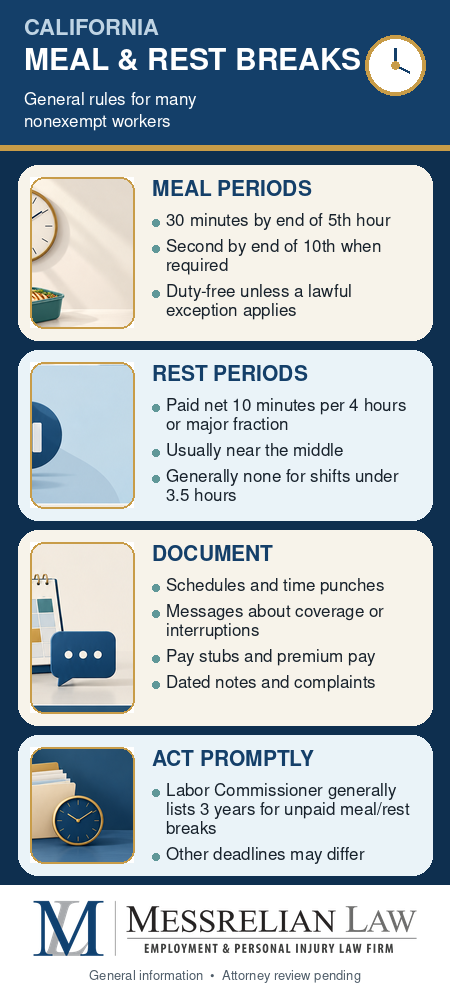
For many covered employees, an employer may not employ someone for more than five hours in a day without providing a meal period of at least 30 minutes. The first meal period generally must begin no later than the end of the fifth hour of work. If an employee works more than ten hours, a second 30-minute meal period generally must begin no later than the end of the tenth hour.
The California Labor Commissioner’s meal-period guidance explains both the timing rules and important exceptions. A first meal may be waived by mutual consent when the total work period is no more than six hours. A second meal may be waived by mutual consent when the total work period is no more than twelve hours and the first meal was not waived. A waiver does not automatically excuse a late or missed meal outside those limits.
A meal period generally must be free from employer control
Providing a meal period requires more than placing “lunch” on a schedule. The employer generally must relieve the employee of all duty, relinquish control over the employee’s activities, allow a reasonable opportunity for an uninterrupted 30-minute break and avoid impeding or discouraging the break. An employer does not have to ensure that no work is ever performed after a compliant meal period is provided, but a policy can be undermined by workload, instructions or pressure that makes taking the break impractical.
The distinction is factual. An employee who freely chooses to work after being fully relieved presents a different issue from an employee who must monitor a radio, answer a phone, help customers, remain responsible for a work area or complete an assignment that cannot reasonably wait. If the employer knows or has reason to know that work is performed during a meal period, the work time may also need to be paid even when the employee chose to continue working.
On-duty meal periods are a limited exception
An on-duty meal period is not a convenient substitute for staffing. The Labor Commissioner explains that it is permitted only when the nature of the work prevents the employee from being relieved of all duty and the employer and employee have a written agreement for a paid on-duty meal. The agreement must state that the employee may revoke it in writing at any time. Whether the nature of the work prevents relief is judged objectively, and special wage-order provisions may apply.
Workers should preserve any meal-period waiver or on-duty agreement. Note when it was presented, whether it was described as optional, which shifts it was applied to and whether actual conditions matched the stated reason for using it.
California rest periods are paid and generally duty-free
For many nonexempt employees, California requires a paid net ten-minute rest period for every four hours worked or major fraction of four hours. The Labor Commissioner treats more than two hours as a major fraction. A rest period is generally not required when total daily work time is less than three and one-half hours. When practicable, the break should occur near the middle of the work period.
The agency’s rest-period guidance states that rest time counts as time worked. That means the employee should not clock out for the required rest period. The employer also generally must relieve the employee of duties and control over how the break is spent. Requiring someone to remain on call, monitor a device or respond when needed can be inconsistent with a duty-free rest period. Travel time to and from an appropriate resting area also should not reduce a “net” ten-minute break to a shorter period.
Rest periods are not ordinarily banked so an employee can arrive late, extend lunch or leave early. A different time may be used when the nature or circumstances of work make the preferred midpoint impracticable, but the employee still generally must receive the required break. Industry-specific rules can alter details, so the applicable wage order should be checked before reaching a conclusion.
Patterns that may deserve closer review
A single unusual day does not explain an entire employment practice. Repeated patterns, however, can help identify what needs investigation. Facts worth documenting include:
- A meal period routinely begins after the fifth hour or is recorded as exactly 30 minutes when it was shorter.
- The time system automatically deducts a meal even when the employee worked through it.
- A manager edits punches or asks an employee to record a compliant break that did not occur.
- Employees must remain responsible for calls, customers, equipment, residents, patients or deliveries during a break.
- Staffing, production quotas or deadlines make relief unavailable, and management knows the problem persists.
- A supervisor discourages breaks, criticizes workers for taking them or treats missed breaks as the employee’s fault without addressing workload or coverage.
- Rest periods are combined with meal periods or used to justify an early departure without the required rest time being provided.
- A pay stub does not show any additional payment after the employer acknowledges a missed required break.
Context matters. A late lunch shown by the time record may be explained by a valid waiver or a different rule, while a facially compliant punch may not show that the employee was required to keep working. The goal of documentation is to preserve the facts needed to evaluate those possibilities.
What to document after a missed or interrupted break
Create a dated break log
For each day at issue, record the scheduled start and end of the shift, actual clock-in and clock-out times, when each meal or rest period began and ended, and whether it was interrupted. Describe the work performed and who requested it. If the problem resulted from customer demand, lack of coverage or a standing instruction, identify that circumstance without guessing about management’s motive.
Prepare notes as soon as practical and state when they were written. If a time is an estimate, label it as an estimate and explain what refreshed your memory. A consistent, honest log is more useful than false minute-by-minute precision reconstructed months later.
Preserve time records, schedules and pay information
Save lawfully available timecards, schedules, pay stubs and records of any premium payment. Keep the complete document rather than only a cropped screenshot. If a punch was edited, preserve the version you received and any notice or message explaining the change. Compare the schedule with what actually happened instead of treating either one as automatically conclusive.
California’s Supreme Court has held that employers may not round meal-period punches, and records showing short or delayed meals can carry legal significance. That does not mean a timecard alone decides every claim. It makes accurate source records and explanations of any correction or interruption especially important.
Keep communications about coverage and workload
Preserve messages that direct an employee to delay a meal, remain available, return early or continue a task. Also keep requests for relief and the response. Complete message threads are better than isolated lines because they show timing and context. Policies, handbooks, training acknowledgments and waiver forms may help explain what the employer said should happen.
Do not take records you are not entitled to access, use another person’s credentials or collect unrelated confidential material. Recording a conversation raises separate privacy and consent questions. Ask a lawyer before making a recording instead of assuming a workplace dispute authorizes it.
Document complaints and the employer’s response
Write down when a break concern was reported, to whom, what was said and what happened next. Preserve emails, texts, complaint forms, scheduling changes, disciplinary notices and payroll corrections. If a conversation occurred verbally, a dated factual note can help preserve memory. Avoid exaggerating what another person admitted.
Identify coworkers who personally observed the practice, but do not pressure anyone to provide a statement or copy their private records. A witness list should separate what the worker personally knows from what others may know.
Premium pay and filing deadlines require a claim-specific review
California Labor Code section 226.7 generally provides an additional hour of pay at the employee’s regular rate of compensation for each workday an employer fails to provide a required meal or rest period. The meal and rest rules are separate, and the correct calculation can depend on the facts, the regular rate and which obligations were not provided. Ordinary wages for work performed during an unpaid meal may present an additional question.
The Labor Commissioner’s current wage-claim filing guidance lists three years for violations involving unpaid meal and rest breaks. That general period should not be used to calculate a final filing date without advice. Related wage, retaliation, contract, representative-action or court claims may follow different rules, and events that seem connected may have different accrual dates. An internal complaint or payroll discussion should not be assumed to pause a legal deadline.
Workers can file a wage claim with the Labor Commissioner, and some disputes may be brought in court. The appropriate route depends on the claims, parties, evidence, agreement terms and requested remedies. Filing one type of complaint does not necessarily preserve every other claim.
California protections differ from federal break rules
California’s detailed break rules are not supplied by the federal Fair Labor Standards Act. The U.S. Department of Labor’s breaks and meal periods overview explains that federal law generally does not require employers to provide meal or rest breaks. When an employer offers short breaks, usually five to twenty minutes, federal law generally treats them as compensable work time. A bona fide meal period is generally not compensable under federal law when the employee is completely relieved of duty.
California employees may be protected by both systems, but the laws do not use one interchangeable standard. A worker should identify where the work occurred, which laws cover the employment and whether a local or industry-specific rule adds another layer. Los Angeles or Glendale location does not change the statewide break standard by itself, although other local wage rules may affect separate pay issues.
Practical next steps for a California worker
Start with the records already available and a short timeline of representative days. Keep working notes separate from original documents. If the employer has a reporting process, consider whether and how to raise the issue, but do not assume an internal complaint replaces a filing or extends a deadline. Preserve any response, correction or payment.
Avoid making an immediate resignation decision based only on a general article. A worker’s classification, industry, agreement, retaliation concern and current employment status can change the available options and risks. Before signing a release, repayment agreement or settlement concerning wages, ask what rights it addresses and what it requires.
Messrelian Law’s employment law practice includes wage-and-hour matters such as meal and rest break issues. A case evaluation can examine the actual schedule, duties, policies, time records and pay information rather than treating every missed-break concern alike.
Frequently asked questions
Is a 30-minute lunch lawful if it begins after my fifth hour
For many covered nonexempt employees, the first meal generally must begin no later than the end of the fifth hour. A full 30 minutes that starts later may still raise a timing issue. A valid waiver, industry rule or other exception can affect the analysis, so preserve the shift record and any agreement.
What if my timecard shows lunch but I kept working
Record what work you performed, who knew about it and how the meal entry was created. An automatic deduction or recorded punch does not necessarily show that you were relieved of all duty. Preserve the original timecard, schedule and messages without altering them.
Can I voluntarily skip lunch to leave early
Working through a required meal does not automatically entitle an employee to leave early. A compliant meal waiver is available only within limited statutory conditions. A personal choice to work after the employer genuinely provides a duty-free meal also differs from pressure, workload or instructions that impede the break.
Can my employer require me to answer calls during a rest period
California rest periods generally must be duty-free. Requiring an employee to remain on call or monitor communications may conflict with the employer’s duty to relinquish control. The exact workplace rule, duties and applicable wage order should be reviewed.
Does signing a meal-period waiver settle the issue
No single form answers every question. The waiver must fit the applicable legal conditions, and an on-duty meal agreement has additional requirements. Keep the signed document and note how it was presented and used in practice.
Do remote employees receive meal and rest periods
Remote work does not by itself remove California wage-and-hour protections. Coverage, classification and where the employee works still matter. A remote worker should document meeting schedules, communications, workload and any expectation to stay available during breaks.
Am I exempt from break rules because I receive a salary
Not necessarily. Salary is only one part of an exemption analysis. Actual duties, compensation and the specific exemption requirements matter. Preserve the job description, pay records and information showing the work actually performed.
What if the timekeeping system rounds my meal punches
California’s Supreme Court has rejected rounding of meal-period time punches. Preserve the raw punches, displayed edits and payroll records. Whether a particular record supports premium pay or another remedy still depends on the complete facts.
Can an employer retaliate because I asked about missed breaks
California law can protect workers from retaliation for asserting wage-and-hour rights. Document the complaint and any later change in hours, duties, discipline or employment status. Retaliation follows different elements and may involve different filing procedures and deadlines, so seek advice promptly.
How long do I have to pursue a missed-break claim
The Labor Commissioner generally lists three years for unpaid meal and rest break claims. That statement does not calculate the deadline for every possible claim, filing route or exception. Identify the earliest disputed date and obtain a claim-specific limitations review rather than waiting until the general period is nearly over.
Discuss a meal or rest break concern with Messrelian Law
If you work or worked in Los Angeles or Glendale and have questions about meal or rest breaks, you can request a free case evaluation or call Messrelian Law at (818) 484-6531. The office is located at 101 N. Brand Blvd., Suite 1450, Glendale, CA 91203. Bring the records you have and identify any missing timecards, schedules or messages. The evaluation can focus on the rule that applies to your work and the facts that still need investigation.