

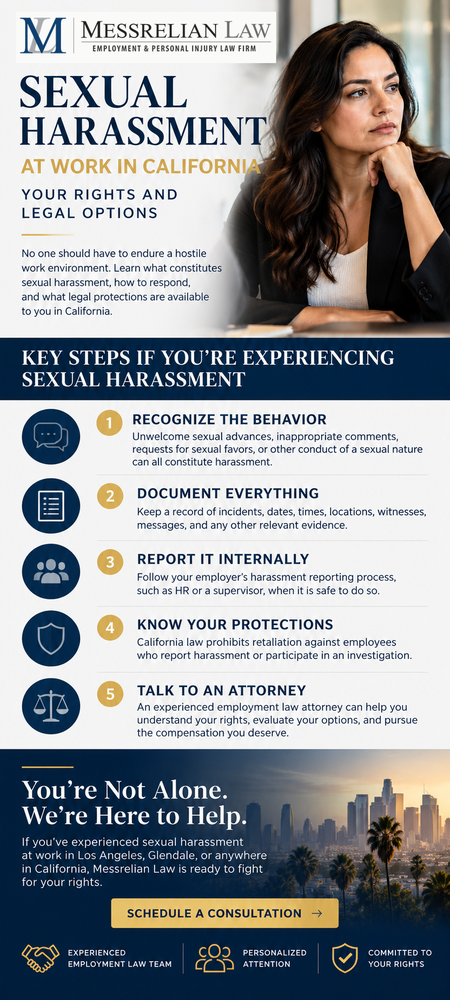
 If someone at work has made unwanted sexual comments, touched you without permission, or pressured you for a date or sexual favor, you may be wondering whether the conduct is illegal and what you can do about it. California law protects workers against unlawful sexual harassment, including conduct by supervisors, coworkers, and in some circumstances other people encountered through work. You do not have to decide on your own whether every legal requirement is met before seeking information or documenting what happened.
The practical questions are often immediate: Should you report the conduct? What if the person involved is your manager? Could you lose your job for speaking up? And how long do you have to act? The answers depend on the circumstances, but understanding the basic protections can help you make informed decisions.
What counts as sexual harassment under California law?
Sexual harassment is a form of unlawful workplace harassment connected to sex. It can involve unwanted sexual advances, requests for sexual favors, sexual comments, gestures, images, or physical contact. Harassment can also involve conduct directed at someone because of sex, even when the conduct is not motivated by sexual attraction.
California’s Fair Employment and Housing Act, often called FEHA, provides workplace protections against harassment. Federal Title VII also prohibits sexual harassment for covered employers. The rules are related, but they are not identical. California’s harassment protections extend to workplaces with very few workers, including those with only one employee or independent contractor on staff, while federal Title VII generally applies to employers with at least 15 employees.
Not every uncomfortable interaction violates the law. The context, seriousness, frequency, effect on working conditions, and relationship between the people involved may all matter. A single serious incident may be enough under applicable standards; a worker should not assume that harassment must continue for months before it matters.
Unwanted conduct can take many forms
Examples may include repeated sexual remarks about someone’s body, persistent requests for dates after rejection, sexually explicit messages, unwelcome touching, exposure to sexual images, or threats connected to sexual cooperation. Conduct may occur in person, through work messaging systems, by text, during business travel, or at work-related events.
An employee does not necessarily have to be the direct target of every comment to be affected by a hostile work environment. Likewise, harassment may involve people of any gender or sexual orientation. Whether conduct is legally actionable requires a fact-specific assessment, not a checklist of words or gestures.
Two common ways sexual harassment appears at work
Sexual demands tied to job benefits or penalties
A supervisor might suggest that a promotion depends on going on a date, or threaten a negative evaluation if an employee refuses sexual contact. This is commonly described as quid pro quo harassment: a workplace benefit or disadvantage is linked to sexual conduct. The exact facts, authority of the person involved, and employment action taken matter when evaluating a claim.
A worker may feel unable to refuse openly when the person making the demand controls shifts, pay, assignments, or career opportunities. The fact that someone did not immediately object does not, by itself, settle whether the conduct was welcome.
A hostile work environment
A hostile work environment can develop when sex-based or sexual conduct is sufficiently serious under the applicable legal standard to change the conditions of employment. It may involve repeated sexual jokes, intrusive messages, degrading remarks, unwanted touching, or other behavior that makes work intimidating or abusive.
California law directs courts to evaluate harassment in context rather than treating every incident in isolation. The law does not require a worker to show that productivity fell or that the person became unable to perform the job. An attorney can assess how the conduct, its impact, and the surrounding circumstances fit the governing standard.
Who can be responsible for workplace harassment?
Harassment can come from a supervisor, a coworker, a customer, a vendor, or another person encountered through employment. The identity of the harasser matters because different rules can apply to an employer’s responsibility. For example, California law treats supervisor harassment differently from harassment by coworkers or nonemployees.
For coworker or nonemployee conduct, questions often include what the employer knew or should have known and whether it took appropriate corrective action. A company cannot necessarily avoid responsibility merely because the person behaving improperly was not on its payroll. At the same time, liability is not automatic in every incident involving a third party.
Independent contractors, applicants, unpaid interns, and volunteers may have protections under California harassment law as well. The California Civil Rights Department explains who can bring harassment complaints on its employment information page.
What should you do if you experience sexual harassment?
There is no single response that fits every situation. Your safety, workplace structure, the severity of the conduct, and the possibility of retaliation can affect the next step. The following measures may help you preserve information and understand your options without assuming that you must confront the person involved.
Record what happened while details are fresh
Write down dates, approximate times, locations, what was said or done, and the names of people who may have witnessed it. Include how you responded, if you remember, and any immediate workplace consequences. A clear chronology can help distinguish individual incidents from a broader pattern.
Keep factual notes rather than trying to assign legal labels to every interaction. If you are uncertain about a detail, say so. A reliable record is more useful than a polished narrative that overstates what can be proved.
Preserve evidence lawfully
Relevant evidence might include messages, emails, calendar invitations, photographs of public workplace postings, performance reviews, schedules, or copies of complaints and responses. Preserve what you can lawfully access. Do not take confidential customer information, privileged company files, or another person’s private records merely because you believe they could support a claim.
If your employer controls a messaging system, records may eventually be deleted under routine retention policies. Ask an attorney how to request preservation when appropriate. Avoid editing screenshots in ways that remove context or make their authenticity difficult to evaluate.
Consider the employer’s reporting process
Many employers provide reporting channels through human resources, a supervisor, an ethics hotline, or another designated contact. Read the policy if you can safely access it. If the person involved is your direct supervisor, look for an alternative reporting channel rather than assuming you must report only to that individual.
When reporting, describe the conduct and identify what response you are requesting. Keeping a copy of the report and any follow-up can help establish a timeline. You do not necessarily have to use a particular phrase such as ‘sexual harassment’ for a complaint to raise concerns, but clarity can help the recipient understand the problem.
Take safety concerns seriously
If you face threats, assault, stalking, or immediate danger, prioritize your safety and consider contacting appropriate emergency or support services. An employment complaint process is not a substitute for immediate protection. If you need time away from work or accommodations, ask a qualified adviser about any separate rights that might apply to your circumstances.
What must an employer do after a complaint?
California employers have duties to take reasonable steps to prevent and address unlawful harassment. A meaningful response may involve a prompt, fair investigation, appropriate confidentiality safeguards, and corrective action when warranted. The response should be proportionate to what the employer learns, rather than automatically assuming either the complaint or the denial is correct.
A complaint does not guarantee that an employer will adopt the reporting employee’s preferred outcome. But ignoring a credible report, discouraging employees from speaking up, or allowing the same behavior to continue can raise serious questions. The California Civil Rights Department’s harassment prevention guide explains preventive practices and complaint handling.
An employee can document when a report was made, who received it, whether anyone followed up, and whether the conduct stopped. If the employer’s response seems inadequate, legal advice can help identify the available next steps.
Can your employer retaliate because you reported harassment?
California and federal law generally prohibit retaliation for protected activities such as reporting unlawful harassment, opposing discrimination, or participating in certain investigations or proceedings. Retaliation may include termination, demotion, undesirable reassignment, reduced hours, threats, or other materially harmful treatment connected to the protected activity.
Not every negative decision made after a complaint is automatically retaliation. Timing, explanations, comparison with prior treatment, performance records, and other evidence may matter. A worker who is disciplined after making a report should preserve the relevant communications and seek an individualized assessment rather than assume the timing alone proves the claim.
Protection against retaliation can apply even when an investigation does not ultimately substantiate every allegation, provided the employee’s conduct falls within the applicable protected-activity rules. The EEOC offers additional guidance on reporting harassment and retaliation.
How do California sexual harassment complaints work?
An internal HR complaint and a government civil rights complaint are different processes. Reporting to your employer does not necessarily satisfy an agency filing requirement or stop a statutory filing clock. A worker considering legal action should understand the relevant administrative steps early.
The California Civil Rights Department, or CRD, receives employment discrimination, harassment, and retaliation complaints. In many California employment cases, an individual must complete the applicable CRD administrative process or obtain a right-to-sue notice before filing a civil lawsuit under FEHA. An employee may request an immediate right-to-sue notice rather than have CRD investigate, but choosing that route can have important consequences.
Federal claims under Title VII generally begin with an EEOC charge before a federal lawsuit. State and federal procedures can overlap, but filing in one system should not be assumed to preserve every possible claim automatically. A lawyer can help identify which agencies, respondents, allegations, and deadlines need attention.
Filing deadlines are not all the same
As a general rule, California workers must initiate a CRD employment complaint within three years of the alleged unlawful act, subject to important exceptions and procedural details. The CRD explains its complaint process and right-to-sue options.
Federal Title VII deadlines are often shorter. The EEOC’s Los Angeles office generally describes a 300-day charge-filing period for covered sex-discrimination claims in California, but federal coverage and special rules must be checked. Certain workers, including federal employees, have different procedures and time limits. Do not rely on a general article to calculate your own last filing date.
After an agency notice, a separate deadline may govern filing in court. Some claims may have additional time limits or different procedural requirements. Waiting for an internal investigation to finish can be risky if an agency deadline is approaching.
What evidence can help evaluate a sexual harassment claim?
A legal evaluation often looks at the alleged conduct, the working relationship, how the employer responded, and the harm that followed. Useful materials can include a chronological account, relevant communications, names of witnesses, the employer’s written policies, HR correspondence, and records of schedule or pay changes.
Evidence is not limited to recordings or an admission from the person accused. Circumstantial evidence, consistent contemporaneous notes, and witness accounts may also matter. On the other hand, the absence of a witness does not automatically prove or disprove what happened.
California recording and privacy laws can create additional issues. Do not secretly record conversations or access accounts without permission based on an assumption that doing so will help your case. Ask an attorney about lawful evidence preservation before taking a step that could create a separate problem.
What remedies may be available?
Available relief depends on the legal claim, responsible parties, evidence, and procedural posture. In an appropriate case, remedies may include compensation for lost wages, emotional distress, certain out-of-pocket losses, or other damages permitted by law. Some cases may also involve attorney’s fees, costs, injunctive relief, or punitive damages where the legal requirements are met.
No particular recovery is guaranteed, and not every type of remedy is available against every defendant. An employee who remains employed may have a different set of losses from someone who was terminated. Settlement discussions, agency proceedings, and litigation also involve different practical considerations.
A lawyer can explain how evidence of economic loss, treatment expenses, job-search efforts, and emotional harm may affect an assessment without promising a dollar amount or a particular outcome.
When should you speak with an employment attorney?
Consider seeking legal guidance when harassment is ongoing, the person involved has authority over your job, the employer has not addressed a report, retaliation appears to be occurring, or you are uncertain about a filing deadline. You do not need to wait until you are fired to ask questions.
An attorney may help assess whether the conduct is legally actionable, which people or entities may be responsible, whether an agency complaint is required, and how to preserve evidence lawfully. Counsel can also help you understand the potential advantages and tradeoffs of an internal complaint, agency investigation, right-to-sue request, negotiation, or litigation.
Messrelian Law represents people in California employment matters, including sexual harassment and retaliation. From its Glendale office, the firm serves clients in Glendale and Los Angeles. If you would like to discuss your circumstances, you can request a free case evaluation or call (818) 484-6531. A request for evaluation is not a promise of representation or a particular result.
Frequently asked questions about sexual harassment at work
1. Does sexual harassment have to involve physical touching?
No. Unwanted sexual comments, repeated requests, explicit messages, or other sex-based conduct may qualify depending on their seriousness and context. Physical contact is not a requirement for every harassment claim.
2. Can one incident be enough for a claim?
Potentially. A single sufficiently serious incident may meet the relevant legal standard. Other cases involve repeated behavior. The details matter more than a simple count of incidents.
3. What if the person harassing me is my supervisor?
A supervisor’s authority can affect the legal analysis and the employer’s responsibility. Document what happened and consider using an alternative reporting channel if your supervisor is the person involved.
4. Can a customer or vendor sexually harass an employee?
Yes. Conduct by a nonemployee can create legal concerns. Whether the employer is responsible depends on factors including its knowledge, control, and response to the behavior.
5. Do California harassment laws cover small businesses?
California’s workplace harassment protections can apply even where a business has fewer than five employees. Federal Title VII has a different employer-size threshold, so the applicable legal route should be evaluated separately.
6. Must I report harassment to HR before contacting an attorney?
No general rule requires you to obtain HR’s permission before seeking legal advice. Whether an internal report affects a particular claim or defense depends on the circumstances. Agency filing requirements are separate.
7. What if I reported harassment and my hours were cut?
A reduction in hours after a protected complaint could raise retaliation concerns, but timing alone does not establish unlawful motive. Preserve schedules, messages, and the employer’s stated explanation for the change.
8. Can I file a claim after leaving the job?
Leaving a job does not necessarily eliminate an otherwise viable harassment claim. Deadlines and available remedies still apply, and the reasons for departure may be relevant to the legal analysis.
9. Is an EEOC complaint the same as a California CRD complaint?
No. They are separate agencies operating under different laws and procedures. Coordination may be possible, but workers should verify that each required filing and deadline has been satisfied.
10. How long do I have to bring a sexual harassment claim in California?
California’s general CRD employment complaint period is three years, while applicable federal EEOC deadlines are often shorter. Court filing deadlines and exceptions are separate issues. An attorney should assess the dates in your particular situation promptly.
This article provides general information about California law and is not legal advice. Laws and deadlines depend on the facts and may change. Reading this article or submitting a case evaluation request does not by itself establish an attorney-client relationship.