

When a person dies because of another party’s alleged negligence or wrongful conduct, California law may allow specified family members to pursue a wrongful death claim. The claim is not available to every relative or friend, and the person who files must fit within a statutory category. The recoverable losses also focus on what eligible survivors lost because of the death—not punishment, grief by itself, or every expense connected with the final injury.
The rules can become complicated when family relationships are disputed, several people may qualify, a public entity is involved, or the death may have resulted from professional negligence by a healthcare provider. This guide explains the general framework. A case-specific review is still necessary to decide who has standing, what claims exist, which defendants may be responsible, and when a filing is due.
The short answer: California law defines who may bring the claim
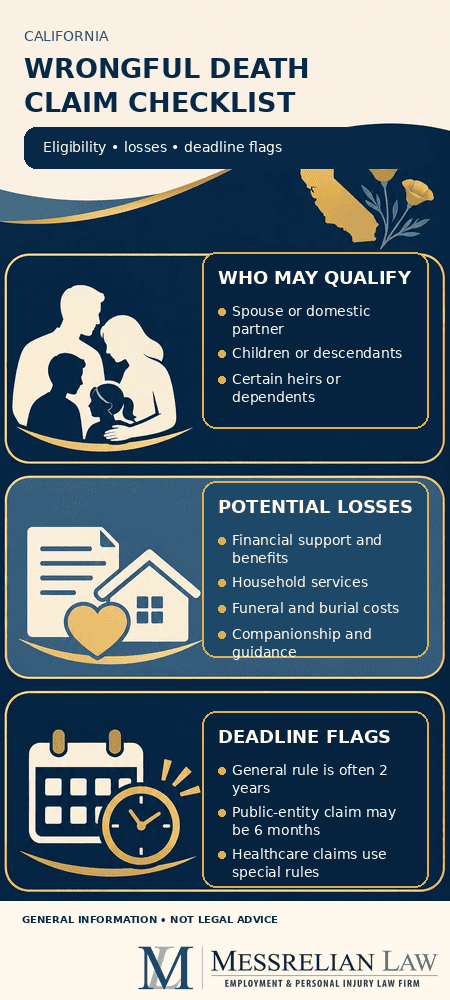
California Code of Civil Procedure section 377.60 identifies the people who may assert a wrongful death cause of action. The principal categories include:
- the decedent’s surviving spouse or registered domestic partner;
- the decedent’s children and the issue of a child who died before the decedent;
- if the decedent left no surviving issue, people who would inherit by intestate succession, which can include a spouse, domestic partner, parents, siblings, or other relatives depending on the family structure;
- certain people who were financially dependent on the decedent, including a putative spouse, children of a putative spouse, stepchildren, and parents; and
- a qualifying dependent minor who lived in the decedent’s household for the 180 days before the death and received at least half of the minor’s support from the decedent.
The statute contains definitions and qualifications that matter. For example, being a stepchild is not automatically enough under the dependency category; dependency must be established. A person who had a close emotional relationship with the decedent may experience a profound loss but still lack statutory standing. Conversely, someone who qualifies under intestate-succession rules may have standing even if the relationship was distant.
Because small differences in parentage, adoption, marriage, domestic-partnership status, dependency, and the existence of descendants can change the analysis, it is safer to map the family tree and support relationships before deciding who may file.
What role does the personal representative play?
Section 377.60 also permits the decedent’s personal representative to bring the wrongful death action on behalf of the eligible claimants. A personal representative is generally the executor named in a will or the administrator appointed in a probate proceeding. That role does not create new beneficiaries or convert the wrongful death recovery into an ordinary estate asset. The representative acts for the people who have the statutory right to recover.
Families sometimes use the phrase “estate representative” loosely. Legal authority to act may require probate appointment or other documentation. The proper claimant analysis should distinguish the person coordinating the lawsuit from the individuals whose losses are at issue.
When more than one person qualifies, California generally treats the wrongful death cause of action as one joint claim. Eligible claimants should be identified and included so the defendant does not face separate lawsuits over the same death. If eligible claimants disagree about allocation, section 377.61 provides that the court determines their respective rights in the award.
What must a wrongful death claimant generally prove?
Standing is only the first issue. A claimant must also establish a legal basis for holding the defendant responsible for the death. The theory may involve negligence, a dangerous condition, a defective product, professional negligence, or another wrongful act. The precise elements depend on that theory.
In a negligence-based case, the evidence usually must address a duty of care, a breach of that duty, causation, and damages. The death must be legally connected to the defendant’s conduct; the occurrence of a death does not by itself establish fault. Liability may also be contested among several parties, and a defendant may argue that another cause contributed to the death.
Evidence can include incident reports, photographs, video, witness accounts, medical and coroner records, expert analysis, insurance information, employment and income records, and proof of family services and support. A prompt investigation can matter because physical evidence changes, surveillance footage may be overwritten, and witnesses’ memories fade.
What economic damages may be available?
Wrongful death damages are intended to compensate eligible survivors for losses caused by the death. They are not automatic, and the claimant must provide a reasonable evidentiary basis for each category. Under the framework used in California’s civil jury instructions, potential economic damages may include:
- Financial support. The support the decedent would reasonably have contributed during the shorter of the decedent’s expected life or the claimant’s expected life.
- Gifts or benefits. Gifts and other financial benefits the claimant could reasonably have expected to receive.
- Funeral and burial expenses. Reasonable costs associated with the funeral and disposition of remains.
- Household services. The value of services the decedent would have provided, such as childcare, transportation, home maintenance, meal preparation, or administrative work.
Calculating support may require more than multiplying the last paycheck by a number of years. The analysis can consider employment history, likely career path, taxes, personal consumption, benefits, retirement contributions, health, and the duration of expected support. For a person who did not earn wages, household services may still have substantial economic value.
Documents that may help include tax returns, wage statements, employment benefit records, bank records showing regular support, household calendars, childcare records, and evidence of recurring tasks. An economist or vocational expert may be needed in a contested case, but the foundation begins with accurate records of what the decedent actually contributed.
What noneconomic damages may be available?
California wrongful death law also recognizes the value of specified personal losses that do not appear on a receipt. Depending on the relationship and evidence, noneconomic damages may address the loss of the decedent’s:
- love, companionship, comfort, care, assistance, protection, affection, society, and moral support;
- training and guidance; and
- for a surviving spouse or domestic partner, enjoyment of sexual relations.
These damages are personal to each eligible claimant. Evidence may describe the relationship, the decedent’s role in the family, the frequency and quality of contact, shared responsibilities, and the guidance or support that would reasonably have continued. Photographs, correspondence, calendars, and testimony from people who observed the relationship can provide context.
There is no universal chart for valuing companionship or guidance. The law does not require an exact mathematical calculation, but an award cannot be based on speculation. A careful presentation connects the claimed loss to the actual relationship without exaggeration.
What is not normally included in wrongful death damages?
The boundaries are important. Grief, sorrow, and emotional distress are real, but California’s standard wrongful death instructions do not treat grief or sorrow by themselves as recoverable wrongful death damages. The focus is the value of the relationship and support the claimant lost.
The decedent’s own pain and suffering is also not a wrongful death damage belonging to the survivors. Claims and losses that belonged to the decedent before death may instead be part of a survival action, subject to the law governing that separate claim. Punitive damages are generally not recoverable in an ordinary wrongful death action, although different remedies may be analyzed in a related survival claim or under a specific statutory exception.
Medical expenses require similar care. If expenses were incurred before death, who paid them and which legal claim owns them can affect whether they belong in a survival action, another damages claim, or a lien analysis. Families should avoid assigning every final expense to “wrongful death” without examining the source of the obligation.
Wrongful death and survival actions are different
A wrongful death claim compensates eligible survivors for their own losses resulting from the death. A survival action preserves certain claims the decedent could have brought had the person lived. It is generally pursued by the decedent’s personal representative or qualifying successor in interest.
The two actions can arise from the same event, but they ask different questions. A wrongful death claim may address lost financial support, household services, funeral expenses, and relationship losses. A survival claim may address losses sustained by the decedent between the injury and death, depending on the facts and current law.
Keeping the claims separate helps prevent double recovery and clarifies what evidence is needed. Estate documents, medical bills, wage records, and proof of the decedent’s pre-death losses may be especially relevant to a survival claim, while proof of support and relationships is central to wrongful death damages. A complaint may plead both types of claims when the legal and factual requirements are met.
Evidence families can preserve without disrupting the grieving process
Families do not need to build a complete lawsuit before seeking advice. A modest preservation plan can protect useful information while avoiding unnecessary burdens.
Start with the death certificate, any coroner or medical-examiner information, incident reports, contact information for witnesses, photographs, and communications with insurers or responsible parties. Keep envelopes and electronic metadata showing when notices arrived. Do not edit the only copy of a photograph or message thread.
For damages, gather recent tax returns, pay records, benefit statements, and documents showing regular contributions to rent, mortgage payments, tuition, childcare, insurance, or other household costs. Make a factual list of services the decedent performed and how frequently. Preserve calendars, messages, and records that illustrate those responsibilities.
Avoid signing broad releases, giving recorded statements, posting case details publicly, or distributing original records without understanding the consequences. If a device, vehicle, product, or location may contain evidence, ask about preservation before it is repaired, discarded, or altered. The Messrelian Law personal injury practice page provides more information about the firm’s injury-related services.
How long do families have to file?
California’s general rule is that an action for death caused by a wrongful act or neglect must be filed within two years. For a typical wrongful death claim, that period generally runs from the date of death. The California Courts limitations guide lists wrongful death under Code of Civil Procedure section 335.1 and emphasizes that different claims can have different periods.
The two-year rule is not a safe universal calendar entry. Important exceptions include:
- Public entities. If a state or local public entity may be responsible, a government claim generally must be presented within six months for a death or personal-injury claim. A separate deadline can begin after written rejection. The California Courts government-claim guide explains the claim-presentation process and warns that multiple deadlines apply.
- Healthcare-provider professional negligence. A death claim based on professional negligence may be governed by Code of Civil Procedure section 340.5 rather than the ordinary two-year rule. California Courts describes a general deadline of the earlier of one year after discovery or when the injury reasonably should have been discovered, or three years from injury, subject to exceptions. Written notice rules can also apply. See the California Courts medical-malpractice guide.
- Other special circumstances. The identity of the defendant, delayed discovery issues, criminal proceedings, bankruptcy, insurance negotiations, and the relationship between wrongful death and survival claims can affect strategy without necessarily extending a deadline.
An insurance claim, an internal investigation, or settlement discussions should not be assumed to stop the limitations clock. Because a missed deadline can bar a claim, families should seek a specific limitations analysis early, even if evidence collection is still underway.
What if several family members may qualify?
Multiple eligible claimants can have different economic histories and relationships with the decedent. One child may have received regular support; another may have relied primarily on guidance and household care. A surviving spouse may have both financial and noneconomic losses. Those differences should be documented rather than compressed into a single family estimate.
At the same time, the claim should be coordinated. Known heirs who may have standing need to be identified, and potential conflicts should be addressed. An agreement among family members does not necessarily change who qualifies under the statute, and the absence of a close relationship does not automatically eliminate statutory standing.
Early coordination can reduce duplicated investigation and inconsistent communications with insurers. It can also reveal whether probate authority is needed, whether a guardian ad litem may be required for a minor claimant, and whether separate counsel should be considered if interests diverge.
Request a case evaluation
A wrongful death evaluation should begin with the family relationships, the event that caused the death, the identity of potential defendants, and the earliest possible deadline. Messrelian Law represents plaintiffs in California personal injury matters and serves clients from its Glendale office. To discuss a potential claim, call (818) 484-6531 or request a free case evaluation. Submitting a request does not by itself create an attorney-client relationship, and no result can be guaranteed.
Frequently asked questions
1. Can a parent file a wrongful death claim for an adult child in California?
Sometimes. A parent may qualify if the adult child left no surviving issue and the parent would inherit through intestate succession. A parent may also qualify under a statutory dependency category when the required financial dependence is established. The full family structure and support history need review.
2. Can siblings file a California wrongful death claim?
Siblings are not automatically listed in the first category. They may have standing if the decedent left no surviving issue and the sibling would inherit under California’s intestate-succession rules. The existence of a spouse, domestic partner, parent, child, or grandchild can change the answer.
3. Can an unmarried partner bring a wrongful death claim?
An unmarried partner does not qualify solely because of a long relationship. A registered domestic partner may qualify, and a putative spouse may qualify if the statutory good-faith and dependency requirements are met. Other facts may affect the analysis, so the relationship’s legal status should be documented.
4. Do stepchildren have standing?
A stepchild may qualify under section 377.60 if the stepchild was dependent on the decedent. The label “stepchild” alone does not establish dependency. Records showing housing, tuition, insurance, regular payments, or other support may be important.
5. Who files if there is a will?
A will may nominate an executor, but it does not rewrite the wrongful death standing statute. A court-appointed personal representative can bring the action on behalf of eligible claimants. The beneficiaries named in a will and the people entitled to wrongful death damages are not necessarily the same group.
6. Are grief and emotional distress recoverable?
Grief and sorrow are not standalone wrongful death damages under California’s standard jury instructions. Eligible claimants may seek compensation for recognized relationship losses such as companionship, comfort, care, guidance, and moral support. A separate direct-injury theory may require different facts and legal elements.
7. Are funeral expenses recoverable?
Reasonable funeral and burial expenses may be included in a wrongful death damages analysis. Records should identify the amount, who paid it, and whether reimbursement or another source covered any portion. Other end-of-life expenses may belong to a different claim.
8. Is the deadline always two years from the death?
No. Two years is the general rule for many California wrongful death actions, but claims involving public entities can require a government claim within six months, and professional-negligence claims against healthcare providers can follow a different statute. The facts and defendant must be reviewed promptly.
9. Can the family bring both wrongful death and survival claims?
Potentially. The claims serve different purposes and have different authorized claimants and damage categories. A wrongful death claim addresses eligible survivors’ losses; a survival action preserves certain claims belonging to the decedent. Both may be pleaded when their separate requirements are met.
10. What should a family bring to an initial evaluation?
Bring the death certificate, incident or police reports, available medical or coroner records, witness information, insurance communications, and any notices from a public entity or healthcare provider. For damages, bring income, benefit, household-support, funeral, and service records. An incomplete file should not delay a deadline review.