

An employee who needs a change at work because of a physical disability, mental disability, or medical condition may be entitled to reasonable accommodation. In California, the request should lead to an individualized discussion about the employee’s limitations, the job’s essential functions, and effective options. The process is not supposed to be a one-time rejection or a demand that the employee solve everything alone. It is a continuing exchange often called the interactive process.
The outcome depends on the job, the medical limitations, the employer, and the available options. An employee is not guaranteed the exact accommodation requested. Still, keeping a clear record of the request, the response, the alternatives discussed, and any later employment action can help show whether both sides participated in good faith. Messrelian Law’s employment law practice represents California employees in workplace disputes, including disability discrimination and retaliation matters.
California and Federal Accommodation Rights Are Similar, but Not Identical
California’s Fair Employment and Housing Act, commonly called FEHA, generally requires employers with five or more employees to provide reasonable accommodation to qualified applicants and employees with physical or mental disabilities unless the accommodation would cause undue hardship. The federal Americans with Disabilities Act, or ADA, generally applies to employers with 15 or more employees. California’s definition of disability can be broader than the federal definition, so a worker should not assume that federal coverage answers every state-law question.
The California Civil Rights Department’s reasonable accommodation guidance lists examples such as changing job duties, providing leave for medical care, modifying schedules, relocating a work area, and providing mechanical or electrical aids. Other possibilities can include modifying policies, making a workspace accessible, or reassigning an employee to a vacant position when the legal requirements for reassignment are met.
An accommodation is intended to remove a workplace barrier so a qualified person can apply for a job, perform essential job functions, or obtain equal employment benefits and privileges. It does not necessarily require an employer to eliminate an essential function, create a new job, displace another employee, or accept an option that would impose an undue hardship. Those questions are fact-specific.
California law also treats the accommodation duty and the interactive-process duty as related but distinct obligations. California Government Code section 12940 addresses failure to make reasonable accommodation, failure to engage in a timely and good-faith interactive process, and retaliation for requesting accommodation. That distinction matters: even when the parties do not ultimately identify a workable accommodation, the quality and timing of the dialogue can still be important.
A Request Does Not Need Special Legal Words
An employee does not need to say “FEHA,” “ADA,” or “reasonable accommodation” to start the discussion. The key is communicating that a work change is needed because of a medical condition or disability. For example, an employee might explain that a medical restriction prevents prolonged standing and ask to use a stool, or that treatment appointments require a temporary schedule adjustment.
A request can be oral, and California does not require use of a particular form. A written request is often helpful, however, because it preserves the date, the limitation described, and the change requested. It can be as simple as:
Because of a medical condition, I am having difficulty performing [task or schedule requirement]. I am requesting [workplace change] and would like to discuss effective accommodations. Please let me know what information you reasonably need.
The employee does not have to identify the perfect solution at the start. The request should give the employer enough information to understand that the need is medical and work-related. A family member, health professional, or other representative may sometimes communicate the need for the employee. An employer may also need to offer to begin the process when it becomes aware of a possible need through observation, a third party, or information that an employee has exhausted leave but may still need an accommodation.
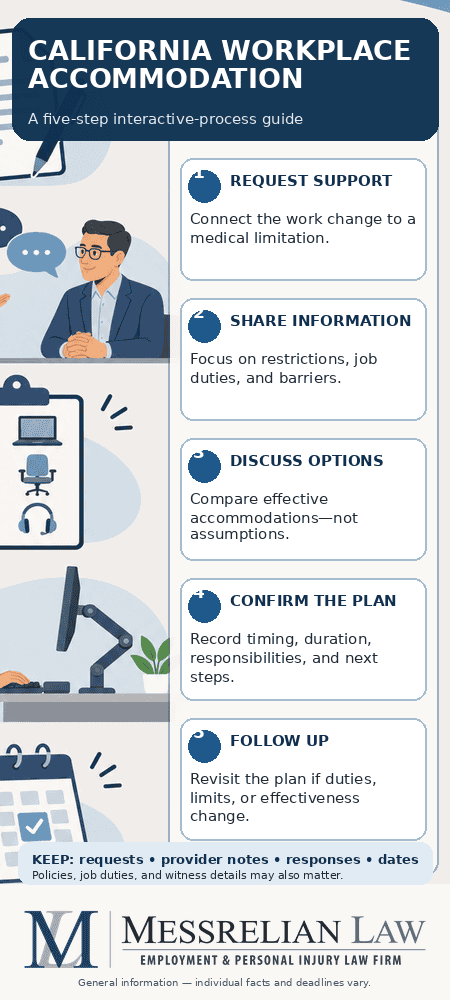
How the Interactive Process Should Work
The interactive process is a timely, good-faith exchange. It should focus on the employee’s functional limitations, the job’s essential functions, and accommodations that could be effective. It is individualized; the fact that one employee received or was denied a particular arrangement does not automatically decide another employee’s request.
1. Identify the Workplace Barrier
The employee should explain what task, schedule, policy, location, or condition is creating difficulty. The explanation does not need to include every medical detail. It should connect the limitation to the work barrier. If the employer does not understand the request, it should seek reasonable clarification rather than simply ignore it.
2. Exchange Relevant Information
When the disability and the need for accommodation are obvious, extensive documentation may be unnecessary. When they are not obvious, the employer may request reasonable medical documentation confirming that a disability exists and explaining the functional limitations and need for accommodation. The inquiry should remain related to the request. California guidance states that documentation can describe limitations affecting a major life activity without requiring disclosure of the underlying medical cause.
Employees can help keep the process moving by responding to reasonable requests, asking for clarification when a request is vague, and giving a provider a current description of the job’s essential functions. Employers should identify what information is missing and allow a reasonable time to provide it instead of treating an incomplete note as the end of the process.
3. Consider Effective Options
Both sides should discuss options that address the actual barrier. Potential accommodations may include equipment, a schedule change, intermittent or finite leave, altered methods for performing a marginal duty, a modified policy, a more accessible location, remote work when effective for the position, or reassignment to a vacant role in appropriate circumstances.
No single option is automatic. Remote work, for example, may be effective for some positions and ineffective for others. Leave can sometimes be an accommodation, but the expected duration and the effect on operations may matter. Reassignment is generally considered in relation to an existing vacant position for which the employee is qualified; it does not necessarily require creation of a new position or promotion.
4. Select and Implement an Effective Accommodation
An employer should consider the employee’s preference, but it may choose another accommodation if the alternative is effective. The U.S. Equal Employment Opportunity Commission’s ADA accommodation guidance explains that an employer may choose among effective options, including a less expensive or less burdensome option, so long as it actually removes the workplace barrier.
Implementation matters. An approval that never takes effect, arrives after an unnecessary delay, or does not address the limitation may not resolve the problem. The parties should confirm who will take the next step, when the accommodation begins, how long it will last if temporary, and when they will reassess it.
5. Follow Up When Circumstances Change
An accommodation may need adjustment if the employee’s limitations, treatment, job duties, or workplace conditions change. A temporary arrangement may require a review date. If an option proves ineffective, the interactive process should continue rather than end with blame. A short written follow-up can document whether the accommodation is working and identify any new barrier.
What Medical Information May Be Requested?
An employer generally may ask for reasonable documentation when the disability or the need for accommodation is not obvious. The documentation can confirm the existence of a covered condition, describe work-related functional limitations, and explain why an accommodation is needed. A provider can often address restrictions—such as limits on lifting, standing, concentration, exposure, or schedule—without disclosing a complete medical history.
The proper scope depends on the situation. An employee should be cautious about sending unrelated records when a targeted note will answer the question. If the employer says the documentation is insufficient, the employee can ask in writing which point requires clarification and what additional information is reasonably necessary. Medical information obtained through the accommodation process is generally subject to confidentiality rules and should not be placed in an ordinary personnel file or casually shared with coworkers.
An employee should also keep a copy of every provider note and the version of the job description given to the provider. If a description is inaccurate or omits duties the employee actually performs, the employee can note the difference. Accurate information helps the provider describe limitations in terms that match the real job.
What Employees Should Document
Good records do not guarantee a legal claim or a particular outcome. They can, however, make the sequence of events easier to evaluate. The California Civil Rights Department’s complaint-process guidance specifically identifies dates, witnesses, request and denial documents, and relevant medical support as potentially useful materials.
An employee may want to preserve:
- The original request, including the date, recipient, workplace barrier, and accommodation proposed.
- Emails, text messages, portal messages, and letters about the request.
- Provider notes, work restrictions, leave certifications, and requests for clarification.
- The job description, written policies, schedules, attendance records, and performance reviews.
- Notes of meetings and calls, including who attended, what options were discussed, and any promised follow-up date.
- Written approvals, denials, delays, or alternative accommodations.
- Evidence showing whether an approved accommodation was actually implemented and effective.
- Records of schedule changes, discipline, reduced hours, transfer, demotion, termination, or other actions after the request.
- Names and contact information for witnesses with firsthand knowledge.
- A timeline listing the last date of each alleged harm, because filing periods may run from specific events.
Workers should preserve records lawfully. They should not take privileged communications, trade secrets, customer information, medical records belonging to other people, or files they are not authorized to access. A personal chronology written close in time to the events can be valuable, but it should separate direct observations from assumptions.
Warning Signs in the Accommodation Process
Not every delay, disagreement, or denial is unlawful. Still, certain patterns may warrant closer review:
- The employer never responds or repeatedly postpones discussion without explanation.
- The employer rejects the requested option without exploring effective alternatives.
- The employer insists on a diagnosis or broad medical history unrelated to the functional limitation.
- A manager tells the employee to resign, go on indefinite leave, or apply for a different job without discussing the current job’s essential functions.
- The employer treats an accommodation request as misconduct or poor attitude.
- An approved accommodation is not implemented, or the employer removes it without discussing whether it remains needed and effective.
- Discipline, reduced hours, exclusion, or termination closely follows the request.
California law prohibits retaliation or discrimination against a person for requesting accommodation, even when the request is not ultimately granted. Timing alone does not prove retaliation, but the dates, stated reasons, comparative treatment, and decision-makers can all matter. An employee who experiences an adverse action should save the relevant notice and ask for the reason in writing when appropriate.
Filing Deadlines Can Be Shorter Than Expected
Internal discussions with human resources do not necessarily extend an agency filing deadline. Under the current CRD process, an employment intake generally must be submitted within three years of the date the employee was last harmed. For a federal ADA charge in California against a covered employer, the EEOC generally uses a 300-day deadline from the alleged harm. The EEOC’s California timeliness guidance also emphasizes prompt contact.
These are general administrative filing periods, not a universal deadline for every claim. The date of harm, continuing or separate acts, employer size, agency processing, government-employer rules, contractual procedures, and possible tolling or exceptions can change the analysis. A denial, failure to engage, retaliatory act, and termination may occur on different dates. Waiting for an internal appeal or for the employer to finish reviewing a request can create risk.
Because deadlines are fact-specific and can affect available remedies, an employee should not wait until the end of a general filing window to seek advice. Preserve the earliest and latest relevant dates and obtain an individualized deadline assessment.
Preparing for a Workplace Accommodation Case Evaluation
A useful case evaluation begins with a clear timeline and the most important records, not necessarily every document an employee has ever received. Bring or organize the accommodation request, medical restrictions, employer responses, job description, relevant policies, performance history, adverse-action notices, witness information, and a list of deadlines or agency contacts.
Messrelian Law serves employees in Los Angeles, Glendale, and throughout California. To discuss whether the facts may involve disability discrimination, failure to accommodate, failure to engage in the interactive process, or retaliation, request a free case evaluation. A request for evaluation does not by itself create an attorney-client relationship, and no outcome can be promised.
Frequently Asked Questions
1. Do I have to use the words “reasonable accommodation”?
No special phrase is required. You should communicate that you need a change at work because of a medical condition or disability. A written request can help preserve what you asked for and when.
2. Is remote work automatically required as an accommodation?
No. Remote work may be effective for some jobs and not others. The analysis usually considers the employee’s limitations, the position’s essential functions, available technology, and whether another effective option exists.
3. Can medical leave be a reasonable accommodation?
Yes, a finite or intermittent leave may be a reasonable accommodation in some circumstances. The expected duration, medical support, the employee’s anticipated return, and undue hardship may matter. Leave rights under other laws can also overlap.
4. Can my employer require a doctor’s note?
When the disability or need is not obvious, an employer may request reasonable documentation confirming the disability and explaining relevant functional limitations and need. The request should not become a demand for unrelated medical history.
5. Must my employer provide the exact accommodation I request?
Not always. The employer should consider your preference but may select a different accommodation if it is effective. A cheaper or easier option is not effective merely because it is convenient for the employer.
6. Can reassignment be a reasonable accommodation?
Reassignment to an existing vacant position may be considered when the employee cannot perform the current position’s essential functions even with accommodation and is qualified for the vacancy. The details are fact-specific, and an employer generally need not create a job or provide a promotion.
7. Is accommodation-related medical information confidential?
Medical information obtained in the accommodation process is generally subject to confidentiality requirements and should be maintained separately from ordinary personnel records. Limited information may be shared with people who need it to implement the accommodation or comply with legal duties.
8. Can an employer retaliate because I requested accommodation?
No. California law prohibits retaliation or discrimination for requesting reasonable accommodation, whether or not the request is granted. Document any closely timed discipline, schedule change, exclusion, or termination and the employer’s stated reason.
9. How long do I have to file a disability-employment complaint?
CRD employment intake is generally due within three years of the last harm. An EEOC disability charge in California is generally due within 300 days for a covered employer. Exceptions, claim types, employer size, and event dates can change the correct deadline, so seek an individualized assessment promptly.
10. What should I bring to a legal case evaluation?
Bring a timeline, accommodation requests, employer responses, provider restrictions, the job description, relevant policies, performance records, adverse-action notices, and witness information. Keep the documents in their original form when possible.