

Being called an independent contractor does not automatically make you one. A company may give a worker a contractor agreement, issue a Form 1099, or pay without payroll deductions, yet the law may still treat that person as an employee for some purposes. In California, the answer generally depends on the realities of the working relationship and the law governing the particular right or claim—not simply the label used by the company.
That distinction can affect minimum wage, overtime, meal and rest periods, reimbursement of necessary business expenses, wage statements, unemployment insurance, workers’ compensation, and other protections. Classification is also highly fact-specific. California and federal law can apply different tests, and California has statutory exceptions for certain occupations and business relationships. Workers in Los Angeles, Glendale, and elsewhere in the state should avoid assuming that either a 1099 or a job title resolves the question.
This guide explains the main California framework, the records that may help evaluate a classification dispute, and the routes a worker may consider before a claim-specific deadline passes.
What Is Independent Contractor Misclassification?
Misclassification occurs when a person is treated as an independent contractor even though the applicable law treats the person as an employee. The practical problem is not the use of contractors itself. California businesses may lawfully engage genuine independent businesses. The problem arises when a company applies the contractor label to a relationship that does not satisfy the governing legal test.
The distinction is important because employees and independent contractors do not receive the same protections. For example, an employee may be entitled to California minimum wage and overtime rules, required meal and rest periods, reimbursement for necessary work expenses, and payroll records. Independent contractors ordinarily price and operate their own businesses and bear different financial risks.
No single document necessarily settles the issue. The California Labor Commissioner’s independent-contractor guidance explains that signing an agreement or receiving a 1099 does not, by itself, determine employment status. A factfinder may examine how the parties actually worked together.
California’s ABC Test
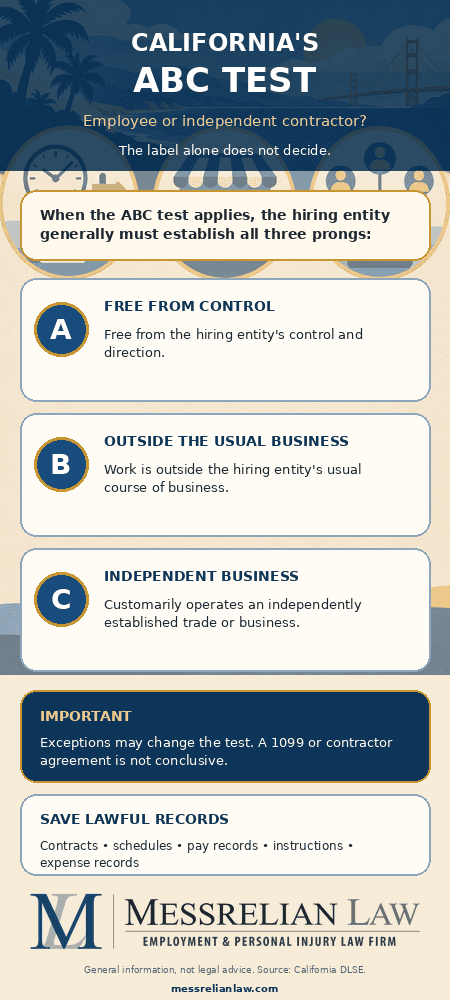
For many California Labor Code, Wage Order, and unemployment-insurance questions, the starting point is a presumption that a person who provides labor or services for pay is an employee. The hiring entity generally must establish all three parts of the ABC test to classify the worker as an independent contractor, unless a statutory exception applies.
A: Freedom From Control and Direction
The worker must be free from the hiring entity’s control and direction in performing the work, both under the parties’ contract and in practice.
Relevant facts can include who decides when, where, and how the work is performed; whether the company supplies detailed instructions; who supervises performance; and whether the worker can make meaningful operational decisions. Some coordination is possible in a legitimate contractor relationship, so control is not evaluated by counting instructions in isolation. The overall arrangement matters.
B: Work Outside the Hiring Entity’s Usual Course of Business
The worker must perform work outside the usual course of the hiring entity’s business.
This prong asks whether the work is part of what the business ordinarily provides to its customers. A retail store that hires an outside plumber for a one-time repair presents a different relationship from a company that regularly sells the same service its so-called contractors perform. Job titles and separate payroll systems do not change the underlying nature of the work.
C: An Independently Established Trade, Occupation, or Business
The worker must be customarily engaged in an independently established trade, occupation, or business of the same nature as the work performed.
Facts may include whether the worker markets services to other customers, maintains a genuinely independent business, sets prices, makes business investments, carries appropriate licenses or insurance, and can continue operating after the relationship with the hiring entity ends. Merely having the theoretical right to work for others may not be the same as actually operating an independent business.
The hiring entity generally must satisfy A, B, and C. Failing one prong may mean the ABC test does not support contractor status. But that is not the end of every analysis because exceptions and other laws can change the applicable standard.
When an Exception or the Borello Test May Apply
California’s classification statutes contain occupation- and relationship-specific exceptions. Depending on the facts and the legal claim, an exception may direct the analysis to the multifactor test associated with S. G. Borello & Sons, Inc. v. Department of Industrial Relations rather than the ABC test. Other specialized rules, federal preemption principles, or voter-enacted provisions may also affect particular industries.
An exception is not necessarily a finding that the worker is an independent contractor. It may simply change which test applies. Under Borello, the right to control the manner and means of the work is important, but it is not the only consideration. Other factors can include whether the worker is engaged in a distinct occupation or business, the skill involved, who supplies tools and the place of work, the length of the relationship, the method of payment, whether the work is part of the hiring entity’s regular business, and the parties’ understanding.
Because these exceptions contain detailed conditions, workers should be cautious about online lists that say an entire occupation is always exempt. The correct test can depend on the work, the contracting structure, and the specific protection at issue.
Facts That May Point Toward an Employment Relationship
Classification does not turn on a checklist, but these questions can help identify facts worth preserving:
- Does the company set a fixed schedule, assign shifts, or require permission for time off?
- Does a supervisor dictate the methods, sequence, location, or tools used for the work?
- Is the work the same service the company offers customers as its regular business?
- Can the worker negotiate rates, accept or reject projects, and work for competing clients?
- Does the worker advertise an independent business and maintain a customer base apart from the company?
- Who bears the cost of equipment, supplies, travel, a vehicle, software, or a phone used for work?
- Can the worker increase profit through managerial decisions, or is compensation mainly tied to hours or units assigned by the company?
- Is the relationship indefinite and integrated into the company’s regular operations?
- Does the worker use company branding, an internal email address, company systems, or a company title when dealing with customers?
- Can either side end the relationship at will, or is the arrangement tied to completion of a defined project?
Some facts can point in different directions, and their importance varies under different tests. A worker should not make irreversible decisions based on one factor alone.
Rights That Misclassification Can Affect
If a worker should have been treated as an employee under the law governing a claim, the classification may affect several categories of rights. Depending on the facts, those may include:
- unpaid minimum wages or overtime;
- compensation or premiums related to meal and rest periods;
- reimbursement of necessary business expenses;
- accurate itemized wage statements and payroll records;
- paid sick leave or other statutory leave rights;
- unemployment-insurance and workers’ compensation coverage; and
- protection against retaliation for asserting workplace rights.
This does not mean every misclassification dispute produces every remedy. Entitlement may depend on hours worked, applicable Wage Orders, exemptions, records, the responsible entity, and the filing route. Some claims require proof beyond employee status. An individual assessment should separate the threshold classification question from the elements and deadline for each potential claim.
California, Federal Wage Law, and Tax Rules May Use Different Tests
Employment status can be evaluated under more than one law. California’s ABC test may govern a state wage claim, while the federal Fair Labor Standards Act applies an economic-realities analysis. Current U.S. Department of Labor guidance describes a totality-of-the-circumstances inquiry focused on whether a worker is economically dependent on the employer or is in business for themself. The federal factors include opportunity for profit or loss, investments, permanence, control, whether the work is integral to the business, and skill and initiative.
Tax classification is a separate question administered under federal tax law. The Internal Revenue Service commonly organizes relevant facts into behavioral control, financial control, and the type of relationship. A tax form or tax treatment can be evidence, but it does not automatically decide a California wage claim.
As a result, a worker may need to identify the law connected to the specific right being evaluated. A conclusion under one framework should not be casually copied into another.
Evidence to Preserve Lawfully
Classification disputes often depend on details that are easier to establish with records created during the relationship. A worker may consider preserving copies of materials they are lawfully entitled to access, such as:
- contractor agreements, offer letters, handbooks, and policy acknowledgments;
- Forms 1099, invoices, payment statements, bank-deposit records, and tax documents;
- schedules, time records, calendars, dispatch logs, and project assignments;
- emails and messages showing instructions, supervision, required availability, or approval processes;
- records of equipment, mileage, supplies, phone, software, insurance, or other work expenses;
- marketing materials or customer communications showing how the company represented the worker’s role;
- documents showing the worker’s separate customers, advertising, business license, pricing, or ability to negotiate; and
- names of people with firsthand knowledge of how the work was performed.
Keep an accurate chronology and preserve files without editing their substance. Do not take trade secrets, privileged communications, customer data, or materials you are not authorized to access. Do not guess about missing time records. A contemporaneous personal log can identify the basis for an estimate while clearly distinguishing it from company records.
Options for Raising a California Classification Concern
A worker’s options depend on the rights involved and the desired remedy. Potential routes may include:
- A wage claim with the Labor Commissioner. A worker seeking unpaid wages or related amounts may use the state process. The Labor Commissioner explains that worker status can be decided as part of a wage claim.
- A report of a labor-law violation. A worker may report certain widespread or ongoing violations to the Bureau of Field Enforcement.
- A civil action. Some workers pursue claims in court, individually or through another available procedure, depending on contracts, statutes, and the relief sought.
- An administrative or tax inquiry. Unemployment, workers’ compensation, tax, or federal wage issues may involve a different agency and test.
These routes are not interchangeable. The choice can affect available remedies, procedure, and deadlines. Contracts may also contain arbitration provisions, but enforceability and scope require a separate analysis.
Deadlines Are Claim-Specific
Do not assume there is one deadline for “misclassification.” The filing period usually follows the underlying claim. The Labor Commissioner’s wage-claim instructions give examples: some penalties or record-related claims may have a one-year period; an oral promise may have a two-year period; minimum wage, overtime, meal or rest period, sick-leave, deduction, and reimbursement claims may have a three-year period; and a written-contract claim may have a four-year period. Different rules may apply to retaliation, discrimination, unemployment, workers’ compensation, federal claims, or civil actions.
Accrual dates, continuing conduct, equitable doctrines, public-entity rules, and contractual issues can change a limitations analysis. Official examples are not a substitute for calculating the deadline for a particular claim. A worker who is still working, has recently been terminated, or is considering a demand should seek advice promptly rather than waiting for the longest period mentioned online.
Practical Steps Before Requesting an Evaluation
Organize records by date and identify the company or companies involved. Note who hired, supervised, scheduled, paid, and could end the relationship. Estimate regular and overtime hours using a consistent method and identify unreimbursed expenses separately. List the services the company sells and how the worker’s duties fit into that business. If the worker maintained a separate business, preserve that evidence too; a candid review needs facts pointing in both directions.
Avoid deleting messages, altering records, or posting accusations online. Do not sign a new release or classification agreement without understanding its effect. If workplace retaliation or immediate loss of income is a concern, discuss timing and safe communication before confronting the company.
Messrelian Law’s California employment-law practice represents workers in workplace disputes. A worker who wants an individualized review may request a free case evaluation or call (818) 484-6531. An evaluation can identify which test may apply, what additional facts are needed, and which deadlines require attention.
Frequently Asked Questions
1. Does receiving a 1099 automatically make me an independent contractor in California?
No. A Form 1099 describes how a payer reported compensation for tax purposes, but it does not automatically determine status under California wage law. The actual working relationship and the applicable legal test matter.
2. Does an independent-contractor agreement settle the issue?
Not necessarily. The agreement can be relevant, especially to the stated right of control, but a label cannot override how the relationship functions in practice. Courts and agencies may examine the full set of facts.
3. Who has the burden under California’s ABC test?
When the ABC test applies, the hiring entity generally must establish all three prongs: freedom from control, work outside its usual course of business, and an independently established trade or business. A statutory exception can change the test.
4. What if I signed up willingly as a contractor?
Consent to the label does not necessarily waive statutory employee protections. However, the parties’ understanding and the worker’s actual business activity may still be relevant under some tests.
5. Can I be an employee under California law but a contractor under federal law?
Potentially. California wage law, the federal Fair Labor Standards Act, tax law, unemployment law, and other statutes may use different standards. Status should be evaluated under the law connected to the specific claim.
6. Are app-based drivers always covered by the ABC test?
No universal answer applies. Voter-enacted provisions, litigation, specialized statutes, and the particular claim may affect app-based work. Drivers should obtain current, occupation-specific advice rather than relying on a general ABC-test summary.
7. Can a misclassified worker recover expenses paid out of pocket?
Possibly. California employees may have rights concerning reimbursement of necessary expenditures, but recovery depends on employee status, the nature and necessity of the expense, proof, and the applicable deadline.
8. What if the company did not keep my time records?
Preserve schedules, messages, calendars, location records lawfully available to you, payment records, and a good-faith chronology. Missing employer records do not make careful documentation unimportant. Avoid presenting estimates as exact records.
9. Can a company retaliate because I ask about classification or wages?
California and federal laws can protect workers who assert covered workplace rights, but the scope and filing period depend on the conduct and statute. Record what happened, preserve communications, and seek prompt advice if hours, assignments, pay, or employment change after a complaint.
10. How long do I have to bring a misclassification claim?
There is no single deadline for the label itself. The limitations period generally depends on the underlying wage, penalty, contract, retaliation, tax, or benefit claim. Because multiple periods and accrual rules can overlap, have the dates reviewed promptly.