

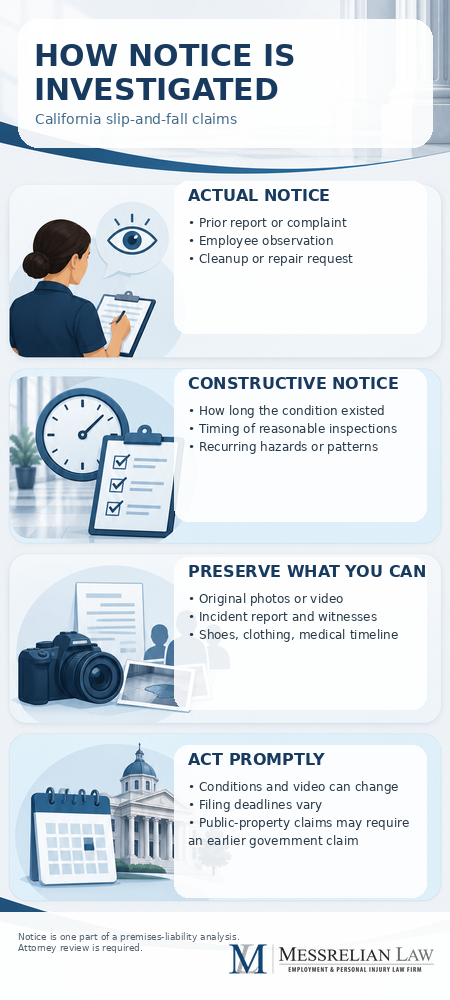
A spill, broken step, loose floor covering, or other property condition may help explain why someone fell. It does not automatically establish that the person or business responsible for the property is legally liable. One disputed question is often notice: did the responsible party know about the condition, or should reasonable care have revealed it in time to repair it, protect people from it, or provide an adequate warning?
Notice can be proven in different ways. An employee may have received a complaint about a spill, creating evidence of actual notice. A condition may have existed long enough that a reasonable inspection should have discovered it, which may support constructive notice. If the owner or an employee created the condition, a different knowledge analysis may apply.
These are fact-specific questions. The condition’s appearance, duration, location, inspection history, prior reports, surveillance footage, and witness accounts may all matter. Preserving that information promptly can make it easier to evaluate a California slip-and-fall or premises-liability claim.
Notice Is One Part of California Premises Liability
California law generally requires people who own, occupy, lease, or control property to use reasonable care under the circumstances. In an unsafe-condition case, the analysis may consider whether the condition created an unreasonable risk of harm, whether the defendant knew or reasonably should have known about it, and whether the defendant failed to repair it, protect against it, or give an adequate warning.
The Judicial Council’s current California civil jury instructions address these issues in the premises-liability instructions, including CACI Nos. 1000, 1001, 1003, 1004, 1011, and 1012. Jury instructions summarize legal principles for use in appropriate cases, but they do not decide whether a particular fall creates liability.
A claimant may still need evidence concerning:
- Who owned, occupied, leased, or controlled the relevant area
- Whether the condition posed an unreasonable risk
- Whether the defendant created, knew about, or reasonably should have discovered the condition
- What reasonable steps were available
- Whether the condition caused the fall and claimed injury
- Whether the injured person’s conduct contributed to the event
- The nature and extent of legally recoverable harm
A fall by itself does not resolve those questions. Notice is important because a property controller ordinarily needs a reasonable opportunity to discover and respond to a condition that someone else created.
Actual Notice Means Evidence of Real Knowledge
Actual notice refers to evidence that the defendant knew about the particular condition before the incident. It does not necessarily require an admission such as “we knew the floor was wet.” Knowledge can be evaluated through documents, testimony, video, and the circumstances.
Possible actual-notice evidence may include:
- A customer, tenant, vendor, or employee reported the condition
- An employee saw the condition during an inspection or while working nearby
- A repair, cleanup, or maintenance request had already been made
- A manager discussed the same defect before the incident
- A warning cone or barrier had been placed near the condition
- Earlier incident reports identified the same location and problem
- Work orders or communications referred to a recurring leak, loose surface, or damaged fixture
The evidence must connect to the condition involved in the fall. General knowledge that spills sometimes happen in a grocery store, for example, is not the same as knowledge of the particular spill at issue. A report about one stair may not establish knowledge of a different defect elsewhere on the property.
Timing also matters. A complaint received shortly before an incident may raise different questions from a report made weeks earlier and followed by a documented repair. The relevant issue may include whether there was enough time to take reasonable protective action after the responsible party learned about the condition.
Constructive Notice Concerns What Reasonable Care Should Have Revealed
Constructive notice does not require proof that someone personally saw or received a report about the hazard. It asks whether, under all the circumstances, the condition was of such a nature and existed long enough that the defendant had sufficient time to discover it and, using reasonable care, repair it, protect against harm, or provide an adequate warning.
This is not a fixed-minute rule. California law does not create one universal period after which every spill or defect is automatically deemed discovered. A jury may evaluate the type of condition, where it appeared, how visible it was, the traffic in the area, the risk involved, and the inspection practices reasonably suited to the setting.
A clear liquid on a busy store aisle may present different discovery issues from a broken stair tread that developed gradually. A condition in a frequently monitored checkout area may be evaluated differently from one in a space rarely accessed by customers. The analysis is tied to the actual circumstances rather than a generic inspection schedule.
The Condition’s Age May Be Shown Indirectly
There may be no witness who knows exactly when a condition began. Circumstantial evidence can still help evaluate duration.
Examples include:
- Dirt, footprints, cart tracks, drying edges, or debris in a spill
- Rust, discoloration, wear, crumbling material, or earlier patching
- Surveillance footage showing the area before the fall
- Time-stamped photographs
- Witness accounts describing when they first observed the condition
- Cleaning or inspection records showing when the area was last checked
- Work orders, repair histories, or prior complaints about the same location
- Weather records when tracked-in water or an outdoor condition is involved
No single fact necessarily proves constructive notice. A footprint in a liquid may show that someone passed through it, but not always when. A missing inspection entry may be relevant, but it does not automatically establish how long the condition existed or decide liability.
Inspection Practices Can Become Important Evidence
In some commercial settings, reasonable care may include inspections suited to the risks of the property. The appropriate frequency and method depend on the circumstances. The law does not require every property to be inspected continuously, and an inspection policy is not automatically reasonable merely because it exists on paper.
Evidence about inspections may include:
- Written inspection or “sweep” procedure
- Time-stamped inspection logs
- Employee schedules and assigned responsibilities
- Cleaning-company records
- Surveillance footage showing inspections
- Digital task-management entries
- Testimony about what employees normally did
- Records showing whether reported problems were closed or left unresolved
A business may contend that an inspection shortly before the incident found no problem. The injured person may question whether the inspection occurred, whether it covered the right area, or whether it was reasonably careful. Those disputes depend on evidence, not on the label placed on a checklist.
When no reasonable inspection was made for a significant period, that fact may support an inference that a condition existed long enough to be discovered. It is not an automatic rule. The condition, location, risk, and surrounding facts still matter.
If the Defendant or an Employee Created the Condition
Notice may be analyzed differently when evidence shows that the defendant or an employee acting within the scope of employment created the dangerous condition. CACI No. 1012 addresses circumstances in which knowledge of an employee-created condition is imputed to the owner.
Examples could include an employee leaving liquid on a walking surface during cleaning, arranging merchandise in a way that blocks an aisle, or creating an unmarked floor-level change during maintenance. These examples do not establish negligence by themselves. The claimant still needs evidence connecting the defendant or employee to the specific condition and showing the other elements of the claim.
It may be disputed who created the condition. Video, work orders, employee assignments, receipts, cleaning records, and witness testimony can become important. An assumption that “an employee must have done it” is not a substitute for evidence.
Evidence That May Help Evaluate Notice
Notice evidence can disappear quickly. A spill may be cleaned, a loose mat moved, surveillance video overwritten, or a damaged surface repaired. Preserving what is safely and lawfully available can help show what the area looked like and identify records that may exist.
Photographs and Video
If it is safe to do so, take photographs from several distances and angles. Include the condition, surrounding area, lighting, walking path, warning signs or lack of signs, and nearby fixtures. Avoid staging the scene, moving objects, adding markers, or returning to an unsafe area solely to obtain a photograph.
Keep the original files. Cropping or sending images through messaging applications can change metadata or reduce quality. A short video may capture reflections, depth, movement, or visibility that one still image misses.
Incident Reports and Communications
Report the incident to the property representative when reasonably possible and request a copy of any report you complete. Write down the name and role of the person who received the report. Do not sign a statement you do not understand or speculate about facts you do not remember.
An incident report is useful, but its absence does not necessarily prevent a claim. Other evidence may establish the date, location, condition, witnesses, and response.
Witness Information
A witness may have seen the fall, observed the condition beforehand, reported it, or heard an employee acknowledge an earlier complaint. Obtain the witness’s name and contact information if the person is willing to provide it.
Record what you personally remember separately. Do not coach witnesses or ask them to adopt your description of the event.
Shoes Clothing and Physical Items
Preserve the shoes and clothing worn during the incident without cleaning, repairing, or discarding them. Store them safely. They may be relevant to arguments about traction, contamination, visibility, and the mechanics of the fall.
Do not take property that belongs to the business or alter the accident scene. Evidence preservation should remain lawful and safe.
Records Controlled by Other Parties
Surveillance footage, inspection logs, cleaning schedules, maintenance records, prior complaints, employee communications, and work orders may be controlled by the property owner, manager, tenant, contractor, or another entity. An attorney may evaluate whether and how to request preservation and later obtain evidence through appropriate legal procedures.
Not every requested record will exist, and not every record will be admissible or prove notice. The purpose is to identify evidence that may help reconstruct what the responsible parties knew and when reasonable care could have revealed the condition.
Notice Does Not Decide Every Other Issue
Even strong notice evidence does not automatically establish a complete premises-liability claim. Other questions may remain disputed.
Control of the Area
The property owner may not be the only potentially relevant party. A tenant, management company, maintenance contractor, vendor, or public entity may control or maintain the area. Contracts, lease provisions, work orders, and actual conduct can help identify responsibility.
An Unreasonable Risk and an Adequate Response
A defect must be evaluated in context. The parties may dispute whether a condition presented an unreasonable risk, whether a warning was adequate, or whether the condition could reasonably have been repaired or isolated before the incident.
Causation and Injury
Evidence must connect the condition to the fall and claimed harm. Medical evaluation and records can document symptoms, diagnosis, treatment, and possible alternative causes. Notice evidence does not substitute for medical proof.
Comparative Fault and Obvious Conditions
A defendant may argue that the condition was visible, that the injured person was distracted, or that safer alternatives were available. California comparative-fault principles can reduce damages based on an assigned share of responsibility, but an obvious condition does not produce the same result in every case. Visibility, necessity of encountering the condition, distractions, warnings, and the defendant’s conduct may all be relevant.
Public Property Has Different Rules and Procedures
A fall on a public sidewalk, government building, transit facility, park, or other public property may involve California’s Government Claims Act and public-entity dangerous-condition rules. The appropriate public entity and the boundaries of public control may not be obvious from the location alone.
For many claims relating to personal injury, a government claim generally must be presented within six months after the claim accrues. Exceptions and late-claim procedures may apply, and filing a government claim is separate from filing a lawsuit. California Courts provides an official explanation of the government-claim process and its deadlines.
Do not assume that a private-property deadline applies to a public-property incident. Identifying the entity, claim form, delivery method, and applicable date can require prompt legal analysis.
Filing Deadlines Depend on the Claim and Parties
California Code of Civil Procedure section 335.1 generally provides a two-year limitations period for an action involving injury caused by another person’s wrongful act or neglect. California Courts likewise lists two years from the injury as the common personal-injury period.
That general rule does not calculate every deadline. Government claims may require action within months. The defendant’s identity, the type of claim, delayed discovery, age or capacity, prior proceedings, and other facts may affect the analysis. Some rules can extend a period; others can create an earlier deadline.
The safest approach is not to wait for the apparent two-year date. Evidence may be lost well before a lawsuit deadline, and a shorter claim-presentation rule may apply. The California Courts deadline overview warns that exceptions can be complicated and that different claims have different time limits.
What Messrelian Law May Review During a Case Evaluation
A case evaluation does not guarantee representation or a particular result. It can help identify the people and entities involved, the evidence relevant to notice, potential deadline issues, and the factual questions that need further investigation.
Helpful materials may include:
- Original photographs and videos
- Incident reports and claim correspondence
- Witness names and contact information
- Receipts or records placing you at the location
- The shoes and clothing worn during the fall
- Medical records, discharge paperwork, and billing information
- A timeline of the incident, reports, symptoms, and treatment
- Communications with the property owner, insurer, manager, or public entity
- Any government claim or written response already received
Messrelian Law handles California slip-and-fall representation as part of its broader personal injury practice. Request a free case evaluation to discuss a slip-and-fall or premises-liability matter. Call (818) 484-6531 or complete the form on the evaluation page.
Frequently Asked Questions
- What Is Actual Notice in a California Slip and Fall Case
Actual notice means evidence that the defendant knew about the particular unsafe condition before the incident. It may be shown through a prior complaint, employee observation, repair request, warning placement, maintenance communication, or other proof. General awareness that hazards sometimes occur is not necessarily knowledge of the specific condition involved. - What Is Constructive Notice
Constructive notice asks whether reasonable care should have revealed the condition even without proof that someone actually saw it. The analysis may consider the condition’s nature, how long it existed, its location and visibility, the risks in that setting, and whether reasonable inspections would have discovered it in time to repair, protect, or warn. - How Long Must a Dangerous Condition Exist Before a Property Owner May Be Responsible
California does not use one fixed number of minutes for every property and condition. The required period depends on all the circumstances, including the nature of the condition, its visibility, the area’s activity level, and reasonable inspection practices. Photographs, surveillance, witnesses, and inspection records may help estimate duration. - Does a Property Owner Have to Inspect for Hazards
Reasonable care may require inspections appropriate to the property and its risks, especially in commercial areas open to customers. The law does not require constant inspection, and the reasonable method and frequency depend on the circumstances. An inspection policy or log is evidence, but it does not automatically prove the inspection was reasonable or performed. - What If an Employee Created the Dangerous Condition
If evidence shows that the defendant or an employee acting within the scope of employment created the condition, California’s jury instructions address imputing knowledge of that condition to the owner. The claimant still needs evidence connecting the employee to the specific condition and must establish the remaining elements of the claim. - What Evidence Can Show That a Business Knew About a Hazard
Relevant evidence may include prior complaints, employee messages, cleanup requests, work orders, warning signs, repair records, surveillance footage, incident reports, and witness accounts. The evidence must relate closely enough to the location, condition, and timing to support the notice issue. - What If There Is No Incident Report
The absence of an incident report does not automatically end a claim. Photographs, witness testimony, receipts, medical records, surveillance, communications, and later property records may still help document the incident. It is useful to write down your recollection while it is fresh without guessing about unknown facts. - Can I Still Have a Claim If I Did Not Photograph the Condition
Possibly, but the answer depends on all the evidence and legal issues. Witnesses, video, inspection records, maintenance documents, physical evidence, and testimony may help establish what occurred. A missing photograph can make proof more difficult, but it does not by itself determine the outcome. - What If I Fell on a Public Sidewalk or Government Property
A government entity may be involved, and California’s claim-presentation rules can require a personal-injury claim to be submitted within six months in many situations. Exceptions and separate lawsuit deadlines may apply. Promptly identifying the correct entity and applicable procedure is important. - How Long Do I Have to Bring a California Slip and Fall Claim
A two-year period commonly applies to California personal-injury lawsuits under Code of Civil Procedure section 335.1, but it is not a universal deadline. Government claims may require action within six months, and other facts or exceptions may change the calculation. A lawyer should evaluate the parties, dates, and claim type rather than relying on a general summary.