
After a vehicle strikes a pedestrian, fault is not decided by one detail such as whether the person was inside painted crosswalk lines. California law assigns duties to drivers and pedestrians, and the full circumstances matter. The location of the crossing, traffic signals, vehicle speed, visibility, witness accounts, video, and each person’s opportunity to avoid the collision may all affect a California pedestrian accident claim.
The first priorities are safety and appropriate medical care. Once the immediate emergency is addressed, prompt evidence preservation can help reconstruct what happened. Some records disappear quickly, and claims involving a city, public agency, or federal vehicle can follow procedures that differ from an ordinary private-driver collision.
California Crosswalk Rules Protect Pedestrians but Still Require Care
California Vehicle Code section 21950 requires a driver to yield the right of way to a pedestrian crossing within a marked crosswalk or an unmarked crosswalk at an intersection, subject to other rules in the same chapter. A driver approaching a pedestrian in that setting must exercise due care, reduce speed, or take other action as necessary to safeguard the pedestrian.
The statute also says that a pedestrian must use due care for personal safety. A pedestrian may not suddenly leave a curb or other place of safety and enter the path of a vehicle that is so close as to create an immediate hazard. A pedestrian also may not unnecessarily stop or delay traffic while in a crosswalk.
Those provisions should be read together. A driver’s duty does not disappear merely because the driver claims the pedestrian entered quickly. Likewise, the presence of a crosswalk does not eliminate every question about the pedestrian’s conduct. A claim may require a careful analysis of distance, speed, sight lines, signals, lighting, distractions, and reaction time.
Marked and Unmarked Crosswalks
A marked crosswalk is shown by painted lines or other pavement markings. An unmarked crosswalk can exist at an intersection even without paint. That distinction matters because someone may lawfully cross at an intersection where no visible stripes appear, while the driver may incorrectly assume that no crosswalk exists.
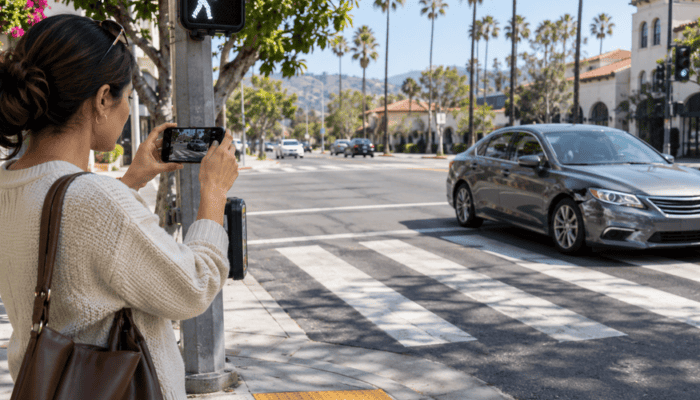
Photographs should capture the entire intersection, not only the point of impact. Useful details may include corner geometry, traffic lights, pedestrian signals, curb ramps, parked vehicles, construction, landscaping, streetlights, and lane markings. A driver’s view and a pedestrian’s view may be different, so several safe vantage points can be helpful.
Crossing Outside a Crosswalk
Vehicle Code section 21954 generally requires a pedestrian crossing outside a marked crosswalk or an unmarked crosswalk at an intersection to yield to vehicles that are so near as to constitute an immediate hazard. The same section states that this rule does not relieve a driver of the duty to exercise due care for a pedestrian on the roadway.
Crossing outside a crosswalk can therefore become important evidence, but it is not an automatic answer to every claim. A driver may still have been speeding, looking at a phone, failing to use headlights, turning without an adequate lookout, or otherwise unable to respond reasonably to a visible hazard. The parties may disagree about when the pedestrian entered the roadway, where the vehicle was, and whether either person had time to avoid the collision.
Comparative Fault Can Reduce Damages Without Automatically Ending a Claim
California uses comparative-fault principles. If more than one person’s negligence contributed to an injury, responsibility may be allocated by percentage. An injured pedestrian’s recoverable damages may be reduced by the share of fault assigned to that pedestrian, rather than the claim automatically disappearing because the pedestrian was partly responsible.
For example, a driver may argue that a pedestrian crossed against a signal, wore dark clothing at night, or looked at a phone. The pedestrian may point to excessive speed, a late turn, an obstructed crosswalk, poor lighting, or the driver’s failure to slow after the danger became visible. Each allegation needs evidence. The Judicial Council’s current California civil jury instructions explain how comparative fault can be presented in an appropriate case, but they do not decide the percentages for a particular collision.
Responsibility may extend beyond the driver in some circumstances. A vehicle owner, employer, rideshare or delivery company, contractor, property controller, or public entity may be relevant depending on ownership, work activity, road conditions, signal operation, or other facts. Those possibilities should be investigated, not assumed.
Evidence to Preserve After a Pedestrian Collision
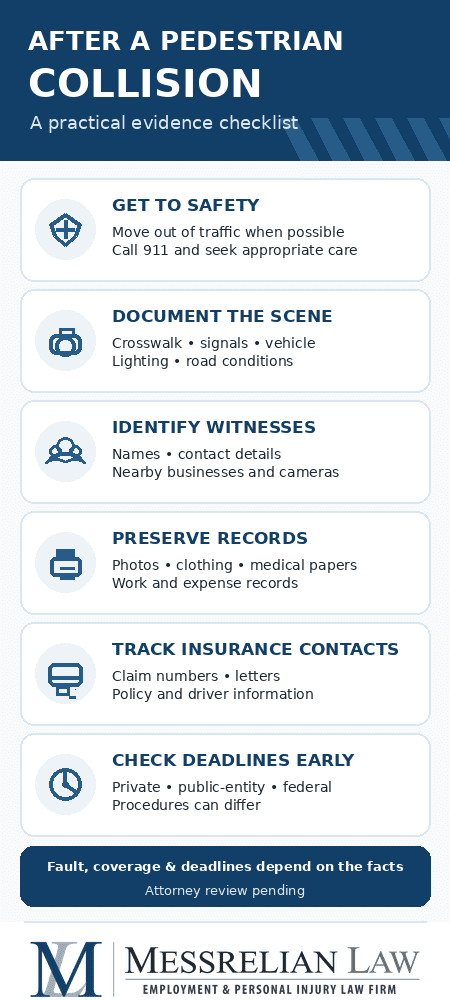
The strongest evidence often combines several independent sources. One photograph or one statement may be incomplete. Preserving available information promptly can help an attorney evaluate fault, insurance, injury causation, and losses.
Scene Photographs and Video
If it is safe and medically appropriate, photographs may show:
- The crosswalk, intersection, roadway, curb, and point of impact
- Traffic and pedestrian signals, including their direction
- Vehicle position, damage, license plate, and debris
- Lighting, weather, shadows, and visibility
- Skid marks or tire paths
- Parked vehicles, signs, trees, construction, or other sight obstructions
- The pedestrian’s clothing, shoes, and personal items
Keep original files. Avoid filters, annotations, or edits to the only copy. If another person took the images, preserve the message or other information identifying the source. Do not return to an active roadway or recreate a scene to fill an evidence gap.
Nearby businesses, residences, buses, vehicles, and public cameras may have recorded the collision. Video can be overwritten on a short or uncertain schedule. Note each possible camera’s location and who may control it. A lawful preservation request does not guarantee that footage exists or will be released, but delay can make the issue harder to investigate.
Witness, Driver, and Report Information
Obtain willing witnesses’ names and contact information. A witness may have seen the vehicle before impact, observed a signal phase, heard a horn or braking, or noticed the pedestrian’s movements. Keep your own memory separate from what someone else reported.
Record the driver’s name, contact details, license information, vehicle plate, and insurance information when reasonably possible. If police or another agency responds, save the report number and agency name. A collision report may be useful, but it does not replace photographs, witness accounts, video, or later investigation.
Physical and Digital Evidence
Preserve the clothing, shoes, backpack, phone, bicycle or mobility device, and other items involved without cleaning, repairing, or discarding them. Store them safely. Do not take property from the scene that does not belong to you.
Phone location history, fitness-app data, vehicle event data, dashcam footage, navigation history, and ride or delivery records may be relevant in some cases. Preserve data you lawfully control and avoid deleting or altering potentially relevant material. An attorney can evaluate whether additional records should be requested from another person or business.
For a fuller checklist of photographs, insurance communications, medical documents, and work records, see the firm’s article on documents to organize for a car-accident evaluation. A pedestrian claim may involve different coverage questions, but many evidence-preservation principles are similar.
Medical Care and a Clear Record of Losses Matter
A pedestrian may experience an obvious injury at the scene or symptoms that become clearer later. Medical decisions should be based on health needs and professional advice, not on trying to create a claim record. Emergency instructions, visit summaries, imaging reports, referrals, prescriptions, bills, and provider information can help document what was evaluated and treated.
Describe symptoms accurately and distinguish personal observations from a clinician’s diagnosis. Relevant earlier injuries or conditions should not be hidden during a confidential legal evaluation. A complete history helps assess causation, alternative explanations, and changes after the collision.
Work and expense records may include pay statements, missed-work dates, employer communications, work restrictions, invoices, transportation costs, and receipts. Self-employed people may need calendars, contracts, invoices, and income records. Keep a dated record of limitations and improvement using concrete examples. Not every cost or difficulty is necessarily recoverable, and evidence of an expense does not by itself prove fault.
Insurance Coverage May Come From More Than One Source
The driver’s bodily-injury liability policy is one possible source, but it may not be the only policy to review. Depending on the definitions, household relationships, vehicle ownership, and policy language, uninsured or underinsured motorist coverage under the pedestrian’s own auto policy or another applicable household policy may be relevant. A commercial, employer, rideshare, delivery, or vehicle-owner policy may also require investigation when supported by facts.
Coverage is not automatic. Insurers may dispute who qualifies as an insured, which policy applies, whether the driver was working, fault, medical causation, damages, notice, or another condition. Preserve declarations pages, full policies and endorsements when available, claim numbers, letters, emails, recorded-statement requests, settlement documents, and proposed releases.
A hit-and-run collision can create additional proof and policy issues, particularly when the driver or vehicle cannot be identified. Prompt reporting and notice may matter under a policy and California law. The exact requirements depend on the facts and coverage, so a general article should not be used to decide whether a particular hit-and-run claim is preserved.
Filing Deadlines Depend on the Defendant and the Claim
California Code of Civil Procedure section 335.1 generally provides two years for an action involving injury caused by another person’s wrongful act or neglect. The California Courts filing-deadline overview lists two years from injury as the common personal-injury period and also explains that different claims have different periods.
That general period does not calculate every deadline. Accrual, delayed discovery, minority, capacity, the defendant’s identity, prior proceedings, and other rules may affect the analysis. Insurance negotiations do not necessarily extend the time to file suit. A pedestrian should not wait for an apparent two-year date before asking which requirements apply.
California Public-Entity Claims Can Require Earlier Action
A collision involving a city bus, public employee, malfunctioning signal, dangerous public roadway condition, or another government connection may implicate California’s Government Claims Act. Government Code section 911.2 generally requires a claim relating to personal injury to be presented within six months after accrual. Presenting that administrative claim is separate from filing a lawsuit, and additional rules govern rejection, late claims, and the time for suit.
The correct entity may not be obvious from a vehicle logo or intersection location. The California Courts government-claim overview explains the separate claim process. Prompt investigation may be needed to identify the agency, the required form and delivery method, and every potentially responsible party.
A Federal Vehicle or Employee Raises a Different Federal Process
Most private pedestrian collisions in California are primarily governed by California law. If the vehicle belongs to the federal government or the driver was a federal employee acting within the scope of employment, the Federal Tort Claims Act may apply instead of the ordinary state public-entity process.
The current official text of 28 U.S.C. section 2401(b) generally requires a tort claim against the United States to be presented in writing to the appropriate federal agency within two years after accrual and a court action to begin within six months after the agency mails notice of final denial. Other federal presentment and exhaustion requirements may also matter. A federal logo or license plate alone is not enough to resolve coverage, employment scope, or the correct defendant, so this distinction needs case-specific review.
When a Legal Evaluation May Be Useful
Early evaluation may be especially helpful when:
- Fault is disputed or the insurer blames the pedestrian
- Crosswalk markings, signals, lighting, or visibility are contested
- Video or digital evidence may be overwritten
- The injuries are serious, lasting, or medically disputed
- The driver left the scene or had little or no insurance
- A commercial, work, rideshare, delivery, public, or federal vehicle was involved
- More than one person or organization may share responsibility
- An insurer has sent a coverage denial, settlement offer, or release
- A filing, notice, or policy deadline may be approaching
Messrelian Law handles California personal injury matters for people seeking to understand their options after an accident. An evaluation can address the facts, available evidence, coverage, potential defendants, and deadlines. It does not promise that a claim will be accepted or produce a particular outcome.
Request a Free Case Evaluation With Messrelian Law
If a driver struck you or a family member while walking, request a free case evaluation with Messrelian Law to discuss the available evidence, insurance issues, and deadlines. Call (818) 484-6531 or complete the form on our free case evaluation page.
Frequently Asked Questions
1. Does a pedestrian always have the right of way in California?
No. Drivers must yield to pedestrians in marked crosswalks and unmarked crosswalks at intersections, but pedestrians also must use due care and may not suddenly enter the path of a vehicle that is so close as to create an immediate hazard. Outside a crosswalk, a pedestrian may have a duty to yield to nearby vehicles. The driver’s duty of care continues in either setting.
2. What is an unmarked crosswalk?
An unmarked crosswalk can exist at an intersection even when no painted lines are present. Whether a particular crossing qualifies depends on the roadway and intersection configuration. Photographs, maps, measurements, and traffic-control evidence may help evaluate the location.
3. Can I have a claim if I crossed outside a crosswalk?
Possibly. Crossing outside a crosswalk can support an argument that the pedestrian shared fault, but section 21954 still requires drivers to use due care. Vehicle speed, visibility, distance, distractions, lighting, and each person’s ability to avoid the collision may affect the analysis.
4. What if the insurer says I was looking at my phone?
The allegation needs evidence and context. Phone records, witness accounts, video, the device’s condition, and the timing of any activity may be relevant. Even if a pedestrian was distracted, the driver’s conduct and other causes still require evaluation under comparative-fault principles.
5. What evidence should I preserve first?
Preserve original scene photographs and video, witness contacts, driver and insurance information, the report number, clothing and shoes, medical records, and insurer communications. Identify nearby cameras quickly. Do not endanger yourself, alter the scene, or delete potentially relevant material.
6. Can a pedestrian use uninsured motorist coverage?
Sometimes, depending on the policy, the pedestrian’s status as an insured, the vehicle involved, household relationships, and other facts. A pedestrian’s own auto policy or another potentially applicable policy should be reviewed rather than assuming coverage exists or does not exist.
7. What if the driver fled the scene?
Call law enforcement when appropriate, seek medical care, preserve witness and camera information, and give prompt notice to potentially applicable insurers. Hit-and-run coverage can have additional factual, reporting, notice, and policy requirements that need specific review.
8. How does comparative fault affect pedestrian accident damages?
If the pedestrian and another party both contributed to the collision, a factfinder may assign percentages of responsibility. The pedestrian’s recoverable damages can be reduced by the pedestrian’s percentage. The result depends on the evidence and is not established by one accusation or traffic citation.
9. Is the deadline always two years after the collision?
No. Two years is a common California period for an ordinary personal-injury action, but government claims, federal claims, policy requirements, and other circumstances can create different or earlier steps. Tolling and accrual issues can also change the analysis. A general date should not be used to calculate a particular deadline.
10. Does submitting a free case evaluation form start a claim or stop a deadline?
No. Submitting a form or speaking during an evaluation does not by itself file a government claim, start a lawsuit, satisfy an insurer’s notice requirement, stop a deadline, or establish an attorney-client relationship. Confirm in writing whether a lawyer has accepted the matter and what work the lawyer has agreed to perform.