

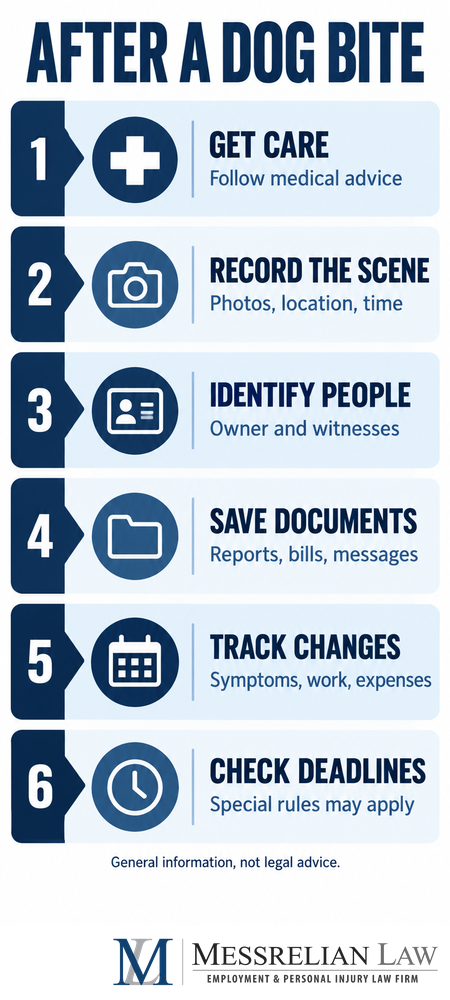
 After a dog bite, your first priorities are safety and appropriate medical attention. Once the immediate situation is under control, preserve a reliable record of what happened. Photos, names, messages, reports, and treatment records can help explain where the incident occurred, who owned or controlled the dog, how the bite happened, and what changed afterward. You do not need to decide on your own whether every legal requirement is satisfied. A careful record gives an attorney a better foundation for evaluating the facts under California law.
Understand what California’s dog-bite rule generally requires
California Civil Code section 3342 makes a dog owner liable for damages when the owner’s dog bites a person in a public place or while the person is lawfully in a private place, including the owner’s property. This rule is often described as strict liability because the injured person does not have to prove that the dog had bitten before or that the owner already knew the dog was dangerous.
That description does not make every claim automatic. The Judicial Council’s 2026 civil jury instructions identify facts a plaintiff still must prove: the defendant owned the dog, the dog bit the plaintiff in a public place or while the plaintiff was lawfully on private property, the plaintiff was harmed, and the bite was a substantial factor in causing that harm. Location, permission, ownership, causation, defenses, and statutory exceptions can all become disputed.
A prior bite history is not a required element of the statutory claim, but information about earlier behavior may still matter to other legal theories or disputed facts. Conversely, a non-bite event—such as a fall while avoiding a charging dog—may require a different negligence analysis. Preserve what happened instead of forcing the incident into a legal label.
Start with evidence that may disappear
Some information is difficult to replace once the scene changes. If it is safe and practical, record the location from several angles. Photograph or video the gate, fence, doorway, walkway, warning sign, leash, damaged clothing, and other physical conditions that may help explain the event. Do not enter property without permission, confront the owner, or put yourself near the dog again to obtain a better image.
Keep the original files. A screenshot can be convenient, but it may omit metadata, the surrounding conversation, or the full image. Save an unedited copy before cropping, marking, or sending anything. Note the approximate time and the exact location in a separate incident timeline while your memory is fresh.
Look for cameras on nearby homes, apartment buildings, stores, vehicles, or doorbells. You may not be entitled to the footage merely because it exists, and the owner of a system may overwrite it quickly. Record where the camera was and ask an attorney about an appropriate preservation request. Do not delay an evaluation while waiting for footage.
The California Courts’ personal injury evidence overview identifies photographs, medical records, witness statements, and police reports as common examples of proof. Saving a record does not guarantee that a court will admit it; evidence rules and authentication still apply. The practical goal at this stage is to prevent potentially useful information from being lost.
Identify the dog, owner, handler, and location
Write down the owner’s and handler’s names and contact information if you can obtain them safely. They may be the same person, but do not assume that the person holding the leash is the legal owner. Record the dog’s appearance, name, collar or tag information, and where the dog was taken after the incident.
Describe the place precisely. Was it a sidewalk, park, apartment common area, business, workplace, delivery route, or private home? If the bite occurred on private property, note why you were there: for example, as an invited guest, worker, customer, tenant, or person performing a duty. Do not exaggerate permission or omit a disagreement about access. Lawful presence can be an important part of the statutory analysis.
Preserve anything that shows the ownership or control arrangement, such as a text inviting you to the property, a photograph of the person walking the dog, a building incident report, or a message identifying the dog’s owner. If the dog was being handled by a walker, sitter, landlord, employer, business, or family member, identify each person and explain what you observed. Liability beyond the owner is fact-specific and should not be assumed from proximity alone.
Document the injury and follow the care you receive
Seek appropriate medical attention based on your condition. This article cannot tell you what treatment you need. Tell the provider what happened accurately and follow medical advice for your health, not simply to create a claim record.
Keep discharge instructions, appointment summaries, bills, pharmacy records, referrals, and communications with providers or insurers. If you photograph visible injuries, use consistent lighting and dates when reasonably possible. Do not edit the only copy or rely on social-media posts as your medical record.
Track symptoms and functional changes in plain language. Note activities you could not perform, work you missed, and assistance you needed. Avoid assigning yourself a diagnosis or copying medical terminology you do not understand. Your observations can help explain daily impact, while clinicians’ records address diagnosis and treatment.
Save damaged clothing or personal items in their post-incident condition when practical. Photograph them before washing, repairing, or discarding them. If you must dispose of something for health or safety reasons, document it first and record why.
Preserve witness information and reports
Ask witnesses for names and reliable contact information. Write down what each person directly observed rather than asking everyone to agree on a group account. A person who saw the dog leave an open gate may have different information from someone who arrived after the bite.
If animal control, law enforcement, property management, a business, or an employer creates a report, save the report number and the name of the agency or organization. Request a copy through the appropriate process when available. Do not assume that calling an agency begins a civil claim or preserves a lawsuit deadline.
Make your own chronology separately. Include what happened before, during, and immediately after the incident; statements you personally heard; the people present; the location of cameras; and when you obtained care. Label later additions. A contemporaneous note can be useful, but certainty is more important than polish—if you do not remember a detail, say so.
Save communications without creating new problems
Preserve complete texts, emails, voicemails, and social-media messages that relate to the dog, the incident, ownership, prior behavior, reports, insurance, or your injuries. Keep enough surrounding context to identify the sender, recipient, and date. Export a conversation when possible instead of relying only on selected screenshots.
Do not access another person’s account, impersonate someone, or pressure a witness to change a statement. Avoid public arguments about fault. A post intended to reassure friends can be read differently when an insurer evaluates the claim, so discuss questions about public posts with counsel.
If the owner or an insurer contacts you, keep the communication and note the date. You can provide necessary identifying information without guessing about medical recovery, accepting blame, or agreeing to a broad release you do not understand. Ask what information is required and consider obtaining advice before a detailed recorded statement or settlement.
Build a record of financial and day-to-day effects
Create a folder for bills and out-of-pocket expenses. Keep records for medical care, medication, transportation, damaged items, and other costs you believe are connected to the incident. A receipt proves a payment occurred; it does not automatically prove the expense is legally recoverable. Keep the source document and let the legal review determine relevance.
For missed work, save schedules, pay statements, employer messages, leave records, and medical work restrictions. If you are self-employed, preserve contemporaneous calendars, contracts, invoices, and business records rather than creating a rounded estimate with no support. Do not ask an employer or provider to change an accurate record.
Emotional and practical effects may not appear on a bill. A dated journal can describe sleep disruption, fear around dogs, interrupted routines, or limits on activities in your own words. Keep entries factual and avoid turning every day into the same repeated statement. Whether a particular impact supports damages depends on proof, causation, and the governing law.
Recognize facts that can change the legal path
Tell the evaluating attorney if the injured person is a child, the dog was performing police or military work, the incident occurred at work, the dog was under professional animal care, the event involved no actual bite, or a public entity may be involved. Civil Code section 3342 contains qualifications for governmental agencies using dogs in military or police work. Courts have also addressed occupation-specific assumption-of-risk issues for some animal-care professionals.
A workplace event may involve workers’ compensation and possibly another claim. A public-entity matter can trigger a government-claim process before a lawsuit. An incident involving federal property, a federal employee, or a federal agency requires separate federal analysis; federal law is not the ordinary source of liability for a private California dog-bite event.
These possibilities do not determine the result. They are reasons to identify every person and organization early, preserve documents from each, and avoid assuming the standard owner-only path is the complete analysis.
Check deadlines before the file feels complete
California Courts lists two years from the injury as the common filing period for a personal injury lawsuit. That is a general rule, not a calculation of your deadline. The official filing-deadline overview explains that deadlines vary depending on why and whom you are suing.
Claims involving a California public entity often require an administrative claim much earlier. California Courts describes a commonly applicable six-month claim-presentation period for personal injury, followed by separate rules after the agency responds. Its government-claim guide also notes exceptions. Minors, delayed discovery, defendants who leave the state, and other circumstances may raise additional questions; do not rely on a general article to extend a date.
An animal-control report, insurance claim, medical appointment, or negotiation does not necessarily start a lawsuit or stop a limitation period. Identify the incident date and every potentially responsible person or entity at the beginning of an evaluation. Seek advice promptly even if records, footage, or bills are still missing.
Prepare a focused case-evaluation file
Organize the material so another person can follow it. Start with a one-page timeline and a list of the dog, owner, handler, witnesses, location, reports, insurers, and treatment providers. Add folders for scene files, communications, medical records, expenses, work impact, and missing evidence.
Do not discard inconvenient material. A conflicting message, uncertain date, or fact the other side may use is part of an honest evaluation. Identify what you know, what you remember, and what still needs verification.
Messrelian Law handles personal injury matters, including dog bites. We can review the facts and discuss possible next steps, but an evaluation is not a promise of representation, compensation, or a particular result.
Frequently asked questions
Does the dog need a history of biting before the owner may be liable?
Not under the basic Civil Code section 3342 rule. The statute does not require proof of prior viciousness or the owner’s prior knowledge. Other facts and defenses still matter, and a claimant must establish ownership, a bite in a covered location, harm, and causation.
What if I do not know who owns the dog?
Record the handler, witnesses, address, dog description, collar or tag, vehicle, and any agency report number. Nearby camera locations may also help. Do not put yourself at risk by following or confronting anyone. Ask how ownership information can be obtained through lawful investigation.
Should I photograph the injury?
Photos can help document visible changes, but they do not replace medical evaluation or records. Keep original dated files when possible, use consistent conditions, and avoid editing the only copy. Seek care based on your health needs.
What if the dog did not break the skin?
Do not decide from that fact alone whether the statute applies or whether harm occurred. Preserve the clothing, photos, medical information, and description of the contact. An attorney can assess the event under the statutory language and relevant case law.
Can there be a claim if a dog knocked me down but did not bite?
Possibly, but Civil Code section 3342 specifically concerns bites. A non-bite injury may require a negligence or other analysis. Evidence about control, prior behavior, warnings, the scene, and how the fall occurred may be important.
What if the bite happened at a friend’s home?
The statute can apply on private property when the injured person was lawfully there, including by invitation. Preserve the invitation or messages, identify the owner, and describe where the event happened. Permission, conduct, defenses, and other facts require individual review.
Should I speak with the dog owner’s insurance company?
You may need to exchange basic information, but you do not have to guess about recovery or sign a release you do not understand. Keep all communications. Consider legal advice before a detailed recorded statement or settlement, especially while treatment and long-term effects remain uncertain.
Does an animal-control report prove my civil claim?
No. A report may preserve useful observations or identifying information, but it does not automatically establish every element, defeat defenses, or determine damages. Keep the report number and request the record through the proper process.
How long do I have to bring a California dog-bite claim?
Many personal injury lawsuits are subject to a general two-year period, but the correct deadline depends on the claim, parties, and exceptions. Public-entity matters can require a claim within about six months. Get a fact-specific deadline review promptly rather than calculating from this article.
Can a parent preserve evidence for a child who was bitten?
Yes. A parent or caregiver can preserve scene files, witness contacts, clothing, medical records, bills, school or activity effects, and communications. Claims involving minors can have special procedural, settlement, and timing rules, so obtain California legal advice rather than assuming the ordinary adult process applies.
Discuss a California dog-bite matter with Messrelian Law
If you or your child was bitten in Los Angeles or Glendale, you can request a free case evaluation or call Messrelian Law at (818) 484-6531. Our office is at 101 N. Brand Blvd., Suite 1450, Glendale, CA 91203. Bring the records you have and identify what may be missing so we can discuss the circumstances and possible next steps.
This article provides general information about California law and is not legal advice. Laws and deadlines depend on the facts and may change. Reading this article or submitting a case evaluation request does not by itself establish an attorney-client relationship.