

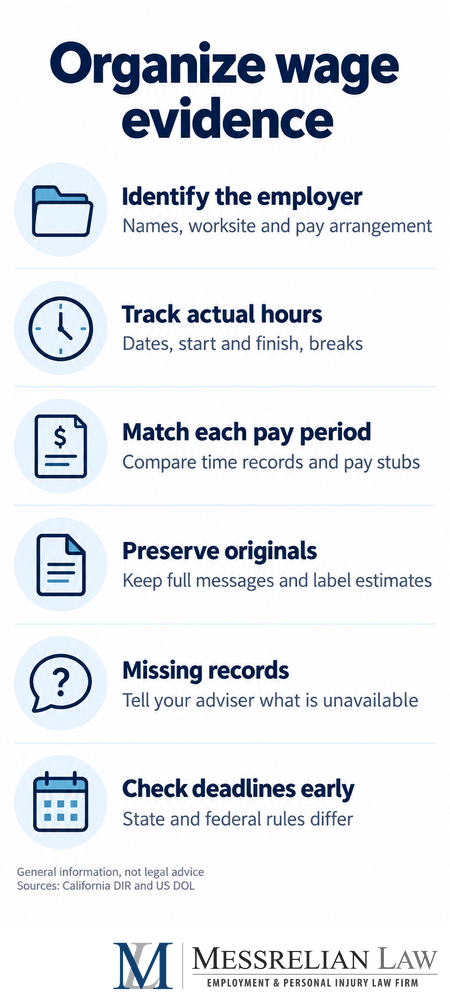
 If your paycheck does not seem to match the work you performed, start by organizing what you know about each pay period. Gather available pay records, reconstruct your actual hours and identify the parts you cannot yet confirm. You do not need a perfect personal time log before asking for help. At Messrelian Law, we handle California employment matters, including wage and hour disputes. A clear record can make an evaluation more useful, but the records still need to be assessed under the law that applies to your work.
Identify the employer and the pay arrangement
Write down the names appearing on your pay stubs, offer letter and work communications. Include the worksite address, the dates you worked there and the people who assigned work or handled payroll. If a staffing company paid you while another business directed your daily work, identify both instead of guessing which one should be responsible.
Then describe how you were supposed to be paid. Save an offer letter, wage notice, commission agreement or messages discussing a rate change. Note when each arrangement began. A worker paid at different rates during different periods needs a timeline that keeps those periods separate, rather than applying the newest rate to the entire job.
The purpose of this first step is to establish the basic facts for review. A name on a uniform, a supervisor’s title or the place where you worked may not answer every question about the legally responsible employer. Bring conflicting names and agreements to the evaluation, including documents that do not fit your initial understanding.
Reconstruct actual work hours without turning estimates into facts
Create a daily record with the date, start and finish times, meal periods and a brief description of the work. If you already kept a calendar or notebook, preserve it. For missing dates, look for lawful sources that can help refresh your memory, such as schedules, messages assigning work and your own calendar entries.
Keep a distinction between a scheduled shift and what actually happened. Note occasions when you arrived early to perform tasks, stayed after the scheduled finish or worked during a period listed as a break. Describe the task and who knew about it. A message’s timestamp can help place an event in context, but it does not automatically establish continuous work throughout the surrounding hours.
Label later reconstructions with the date you prepared them and the basis for the estimate. If you remember a usual pattern but not an exact minute, say so. Do not add invented precision to make a spreadsheet look complete. Your adviser needs to know which entries come from contemporaneous records and which depend on memory.
The Labor Commissioner’s supporting-document guidance for wage claims explains that employers have recordkeeping responsibilities and workers are not required to have kept their own time records to file a claim. Personal notes can still help explain a discrepancy. Missing notes are a reason to discuss the available evidence, not to assume that no review is possible.
Match time records and payments by pay period
Place each pay stub with the time records covering the same dates. A paycheck date and a pay-period ending date are not the same thing, so check the period identified on the statement before comparing totals. Keep records of later corrections with the period they were intended to address.
Use a simple comparison sheet to identify questions rather than announce a final damages figure. Record the hours shown on the time record, the hours shown as paid and any difference you want explained. Separately note rates, deductions and payments that are difficult to match. A bank deposit alone does not explain every component of a wage statement; compare it with the accompanying payroll information.
If you were paid in cash, note each payment’s date, amount and who provided it. Preserve receipts or messages acknowledging payment if you have them. If a check could not be cashed, keep the check information and the bank’s explanation. These details help distinguish an unpaid amount from a payment that arrived late, was corrected or was allocated to another period.
Retain records of bonuses, commissions and changes in compensation. California overtime calculations can involve more than the stated hourly rate, and exemptions or special rules may affect the analysis. Instead of applying one internet formula to every payment, identify the compensation involved and ask how it should be treated in your situation.
Preserve useful records without taking unrelated company information
Keep original files and complete message threads when they are lawfully available to you. Make a separate working copy for highlighting or calculations. If a screenshot is useful, retain enough context to show the date, participants and surrounding exchange. Avoid replacing the only available original with a cropped or annotated version.
Do not assume a potential wage dispute authorizes access to someone else’s account or the removal of confidential company files. Ask an attorney about preservation before collecting material you are not entitled to access, making recordings or copying records containing other people’s private information. If an important record remains on an employer-controlled system, identify it and explain where it is stored.
Keep a short index so another person can find the records you refer to. For example, use a folder for each year and label pay-period files consistently. This is a practical organizing method, not a legal requirement. An adviser should be able to trace a disputed entry back to the underlying document without sorting through an unexplained collection of images.
Explain gaps and conflicting records directly
A missing pay stub, an edited time entry or a schedule you no longer possess should appear on a missing-information list. Say what the record is, which period it concerns and why you think it matters. Distinguish something you once saw from something you only suspect exists.
If your records conflict with the employer’s, describe the disagreement in factual terms. You may remember working after a recorded clock-out or receiving a different amount from the one listed. Preserve the record as it appears and explain your account separately. A discrepancy needs investigation; it does not by itself establish why it occurred or what remedy is available.
Ask how appropriate records can be requested or preserved. Do not wait to seek advice until the employer produces everything. The Labor Commissioner accepts supporting documents when available, and its instructions explain that more information may be requested after filing. The same page provides different worksheets for issues such as irregular hours, commissions and expenses; the useful materials depend on the claim.
Separate the evidence from the legal calculation
The records help answer what happened. The legal review asks which rules apply, whether the work is covered and what compensation may be owed. Relevant questions can include employee classification, an overtime exemption, a special work schedule or the treatment of a particular payment. A label in an agreement should be reviewed with the actual working arrangement.
For example, California guidance distinguishes eligibility for overtime from an employer’s rule requiring advance authorization. In appropriate circumstances, lack of authorization does not eliminate the duty to pay for work the employer knew or should have known was performed. That does not give a worker permission to disregard workplace policies or conceal work from the employer. Preserve instructions and describe the circumstances accurately.
Our employment law practice includes wage and hour matters. We can discuss the facts and the questions that need investigation. An evaluation should not assume that the employee’s first estimate, a payroll label or an employer’s explanation settles the legal issue without examining the supporting information.
Check deadlines while you gather the records
Do not postpone a limitations review while building a complete folder. California’s Labor Commissioner generally lists three years for unpaid minimum-wage and overtime claims, two years for an oral promise to pay more than minimum wage and four years for a written contract. These are different categories, not interchangeable filing periods. The official California wage-claim filing guidance identifies additional categories with different limits.
Federal law has its own coverage, exemptions and timing rules. The U.S. Department of Labor explains that the Fair Labor Standards Act generally has a two-year limitation period for non-willful violations and three years for willful violations. Do not assume a California period also governs a federal claim. The Department’s worker complaint and investigation FAQ explains the federal process and its limits.
These general periods do not calculate your last filing date. The type of claim, when particular wages became due and any applicable exception can affect the analysis. Related retaliation or discrimination concerns may involve a different process. Do not assume that an internal payroll inquiry, a records request or an agency discussion stops a court deadline. Identify important dates early and ask which filings are needed to preserve each potential claim.
Prepare a short summary for an evaluation or agency process
Bring a concise explanation of the problem alongside the underlying records. State when you worked, how you were paid and the periods you believe need review. Identify the strongest examples, the gaps and any approaching date you are worried about. Include earlier complaints, payroll responses and corrections so the reviewer sees the full sequence.
If you already filed something, bring the exact submission, claim number and notices received. A California Labor Commissioner wage claim is different from a federal Wage and Hour Division complaint or a private lawsuit. Choosing one route should not be assumed to resolve every potential issue. Discuss existing filings and proposed agreements before taking another step.
In the California administrative process, a settlement conference may be followed by a hearing if the dispute does not resolve. Organized evidence remains useful at both stages, but a conference is not a ruling that wages are owed. Follow the agency’s current instructions about copies, attendance and presenting evidence. Keep originals available rather than sending away your only copies.
Frequently asked questions
Can I ask for help if I was paid only in cash
Yes. Describe the payment arrangement and preserve whatever receipts, messages or personal payment notes you have. Cash payments can make reconstruction more difficult, but the method of payment alone does not answer whether you were paid correctly. Be clear about amounts you remember and those you can document.
What if my schedule changed every week
Keep the available schedules, but explain actual changes rather than treating each posted shift as conclusive. Note substitutions, shortened shifts and extra work separately. A daily reconstruction is usually easier to review than one average used across months without showing how you arrived at it.
Does a small bank deposit prove unpaid wages
Not by itself. A deposit should be compared with the relevant pay stub, deductions, payments and pay-period dates. Identify what you cannot reconcile and bring the source records. Whether the records show an unlawful shortfall requires more than comparing a deposit with the amount you expected to receive.
What should I do if I lost access to the payroll portal
Write down when access ended, which records are missing and whether you already requested them. Preserve copies you lawfully retained and ask about appropriate ways to obtain the rest. Do not use another person’s login or assume you must regain portal access before speaking with an adviser.
Should I collect coworkers records to support my claim
Do not take another person’s private files. Identify witnesses who may have relevant firsthand information and explain what you believe they observed. Ask counsel how comparisons or witness information should be obtained lawfully. Your own claim should distinguish personal observations from what someone else told you.
Does receiving a 1099 prevent a California wage claim
Not necessarily. The classification issue depends on the applicable legal test and working relationship, not merely a tax form. California’s Labor Commissioner may evaluate whether someone claiming employee protections was misclassified. Bring agreements and a factual description of how the work was directed; do not decide the issue from the label alone.
Can a salaried worker have an overtime concern
Potentially. California’s overtime guidance explains that salary alone does not establish an exemption. Actual duties, compensation and the applicable exemption or special rule need review. Keep records of the work performed and pay received, even if the pay stub does not list an hourly arrangement.
What if the employer later corrects the paycheck
Keep the original statement, correction and any explanation. Record which period the correction covers and whether other discrepancies remain. A later payment is relevant evidence and should not be omitted. Ask how it affects the remaining issues rather than assuming it resolves everything or changes nothing.
Does a union contract matter to the evidence review
Yes. Bring the collective bargaining agreement and any grievance records you have. Tell your adviser about deadlines or procedures the union has identified. The Labor Commissioner specifically asks workers to disclose union coverage; the agreement can affect the questions that need to be evaluated.
Do I have to hire a lawyer to submit a wage claim
The Labor Commissioner provides a process workers can use themselves, and its instructions also address represented claimants. Legal advice may be useful when the responsible parties, classification, calculations or filing routes are disputed. A free case evaluation is not a promise of representation or an outcome.
Discuss a wage concern with Messrelian Law
If you work or worked in Los Angeles or Glendale and have questions about unpaid wages, you can request a free case evaluation or call us at (818) 484-6531. Our office is at 101 N. Brand Blvd., Suite 1450, Glendale, CA 91203. Bring the records you have and identify what is missing. We can discuss the concern without requiring you to turn an initial suspicion into a legal conclusion yourself.