

On October 13, 2025, California enacted Assembly Bill 250, known as the “Justice for Survivors of Sexual Assault Act.” This law significantly changes how the state handles civil statute of limitations for adult survivors of sexual assault.
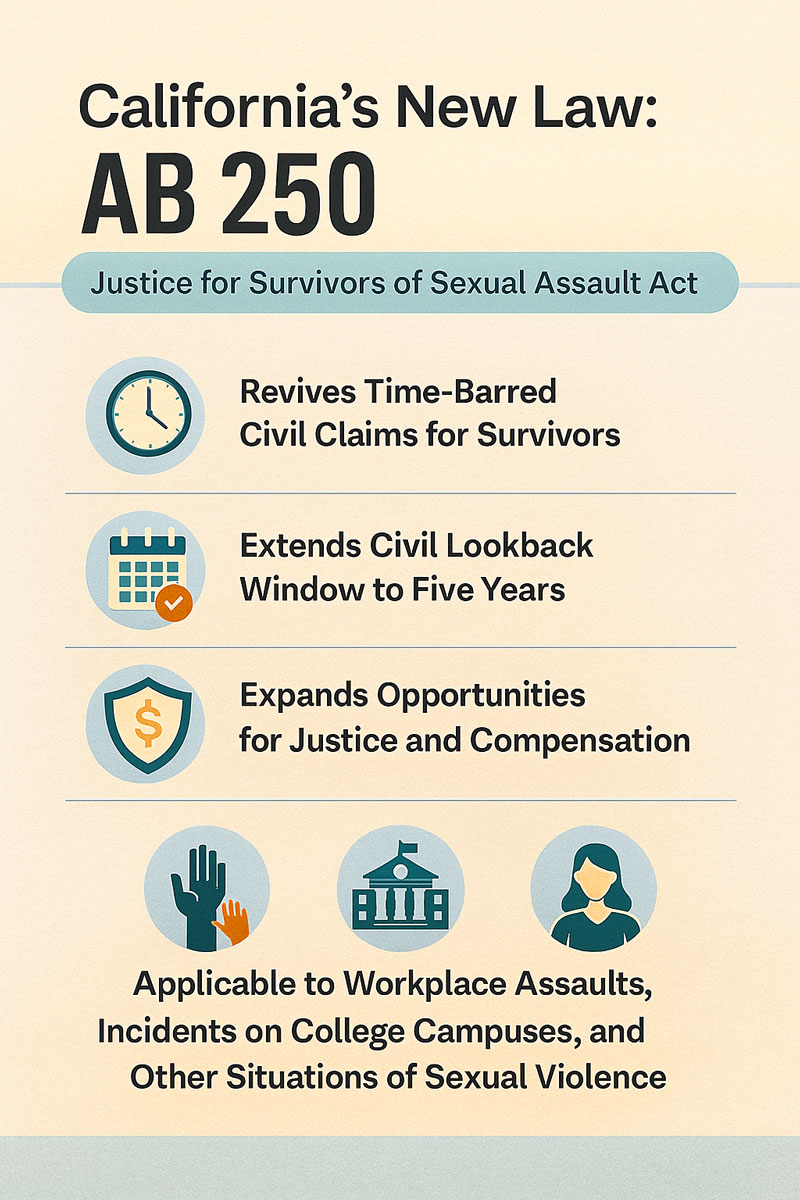 For many people whose claims were previously “too old” to bring to court, AB 250 offers a rare second chance to seek justice.
This article explains:
- Why AB 250 was introduced
- What the law actually does
- Who can benefit from it (and who cannot)
- The main arguments for and against the bill
- Key deadlines and action items for survivors and institutions
Note: This is an informational overview only and does not constitute legal advice. Survivors should consult with an attorney about their specific situation.
1. Why Lawmakers Created AB 250
The Problem With Time Limits and Trauma
Historically, California law gave survivors of sexual assault a limited window to sue. For adults (18 and older), civil claims for sexual assault were governed by deadlines in the Code of Civil Procedure. Once that statute of limitations expired, a survivor generally lost the right to bring a civil lawsuit—no matter how serious the assault or how strong the evidence.
But sexual assault is not a typical injury. Survivors often:
- Take years or decades to process what happened
- Feel intense shame, fear, or self-blame
- Worry about retaliation, job loss, or public exposure
- Face pressure from institutions, employers, or powerful individuals to stay quiet
On top of that, there have been repeated allegations that organizations knowingly covered up sexual abuse to protect themselves—through nondisclosure agreements, destroyed records, internal hush-ups, or simply looking the other way.
Previous laws tried to address this by creating limited “look-back windows” that temporarily reopened old claims. But those efforts left many gaps:
- Some survivors didn’t qualify
- Some ran out of time again
- Others lost their cases due to technical issues like not being able to prove an institutional cover-up
Lawmakers came to believe that too many survivors were still being shut out of court. AB 250 is meant to correct that by reviving certain expired claims and clarifying who can be sued and when.
2. What AB 250 Actually Does
At its core, AB 250 does two big things:
- It reopens a temporary window for many previously time-barred civil claims involving sexual assault of adults.
- It clarifies who survivors can sue, including both perpetrators and certain private entities.
Let’s break that down.
A. New Two-Year “Revival Window”
AB 250 creates a two-year revival period for certain claims that were previously barred only because the statute of limitations had run out.
- The window opens January 1, 2026
- It closes December 31, 2027
During that time, adult survivors (18 or older at the time of the assault) can file civil suits for sexual assault even if the normal deadline expired years ago.
This is not a permanent change to the statute of limitations; it’s a temporary opportunity. After December 31, 2027, the revival window shuts, and standard time limits take over again.
B. Who Can Be Sued Under AB 250
AB 250 allows survivors to bring revived claims against:
- The individual perpetrator
- Survivors can sue the person who committed the assault, even if there is no allegation of an institutional cover-up.
- This is a key shift from some earlier revival laws, which focused heavily on institutions.
- Private entities that allegedly covered up abuse
- Survivors may sue private organizations—such as companies, private schools, churches, non-profits, or other private employers—if they allegedly helped conceal past sexual abuse.
- Concealment can include things like silencing victims with NDAs, mishandling or destroying reports, or protecting abusers instead of victims.
- Related civil claims tied to the assault
- AB 250 doesn’t just revive the core sexual assault claim. It can also revive related civil claims that flow from the same events, such as:
- Wrongful termination
- Sexual harassment
- Retaliation or other employment-related harm connected to the assault or its cover-up
- AB 250 doesn’t just revive the core sexual assault claim. It can also revive related civil claims that flow from the same events, such as:
This means that if someone was assaulted at work and later fired or harassed for speaking up, those related claims may also be revived if they were time-barred.
C. Important Limits
AB 250 is powerful, but it’s not unlimited. Some key limitations:
- Public entities are excluded.
The revival provisions do not apply to public agencies, such as:- State and local government departments
- Public school districts
- Public universities
- Cities and counties
- Previously resolved cases are off the table.
The law does not reopen:- Cases that already went to final judgment
- Claims that were resolved through a written settlement agreement
- The window is strictly time-limited.
If a survivor does not file under AB 250 by December 31, 2027, this special revival opportunity is lost.
3. Who AB 250 Helps — and Who It Doesn’t
A. Survivors Who May Benefit
AB 250 primarily helps:
- Adult survivors of sexual assault whose civil claims are currently barred only because the statute of limitations ran out.
- Survivors whose assaults happened many years or decades ago, but who are only now ready or able to come forward.
- People whose earlier attempts to sue under prior revival laws failed because:
- They could not prove an institutional cover-up, or
- Their claims were dismissed on technical grounds.
Because AB 250 allows lawsuits directly against perpetrators even without proof of a cover-up, some survivors who were previously turned away may get a new chance.
It also benefits survivors with related employment or harassment claims tied to the assault—claims that might otherwise have remained permanently time-barred.
B. Who Is Still Left Out
Despite its broad reach, AB 250 does not cover:
- Claims against public entities, including:
- Public schools
- Public colleges and universities
- Government agencies and municipal bodies
- Cases that were already fully resolved, either by:
- A final court judgment, or
- A written settlement agreement
- Survivors who miss the revival window. After December 31, 2027, AB 250 cannot be used to revive claims.
4. Why AB 250 Was Passed: Key Policy Goals
A. Recognizing Delayed Reporting and Trauma
A major reason for AB 250 is the growing recognition that trauma does not work on legal deadlines. Many survivors:
- Need years of healing before they can speak publicly
- Fear losing jobs, relationships, or community support
- Face shame or disbelief when they try to come forward
Lawmakers wanted to ensure that survivors are not punished simply because it took them a long time to be ready.
By reopening old claims, AB 250 reflects the idea that justice should account for the realities of trauma, not just the passage of time.
B. Holding Institutions Accountable
Another core purpose of AB 250 is to send a message to institutions:
“You cannot hide behind time limits if you helped cover up sexual assault.”
By allowing claims against private entities that allegedly concealed abuse, the law:
- Encourages organizations to take reports seriously
- Discourages the use of NDAs and internal hush-ups to protect abusers
- Promotes transparency, safer workplaces, and stronger reporting systems
C. Fixing Gaps in Earlier Revival Laws
Previous revival statutes had ambiguous language and narrow rules that caused confusion in the courts. Some survivors found that:
- Their cases turned on technical questions about whether a “cover-up” was adequately alleged or proven
- They couldn’t sue the perpetrator directly under certain prior laws
- The filing window wasn’t long enough for them to find counsel and prepare claims
AB 250 seeks to streamline things by:
- Allowing direct claims against perpetrators
- Making clear that related claims can be revived
- Providing a defined two-year window through the end of 2027
5. Support and Criticism: The Debate Around AB 250
Like most major legal reforms, AB 250 has both strong supporters and vocal critics.
A. Arguments in Support
Supporters of AB 250 emphasize:
- Justice for survivors
- Many survivors never had a realistic chance to sue when the abuse happened.
- AB 250 offers long-overdue access to the civil justice system.
- Accountability for institutions
- Organizations that enabled or concealed sexual abuse should not get a “free pass” just because time ran out.
- The threat of civil liability can push institutions toward better policies, training, and reporting mechanisms.
- Correcting past legislative shortcomings
- Earlier revival windows were too narrow or complicated.
- AB 250 gives survivors who fell through the cracks another opportunity.
B. Concerns and Criticisms
Critics raise several concerns about AB 250, including:
- Due process for defendants
- Defending a claim about events that occurred decades ago can be extremely difficult.
- Evidence may be lost, witnesses may be deceased or impossible to locate, and memories may have faded.
- Some argue that this can result in unfair trials and undermine confidence in civil verdicts.
- Financial impact on private entities
- Businesses, non-profits, religious organizations, and private schools may face large and unexpected liabilities for old incidents.
- For smaller organizations, a single verdict could be financially devastating.
- Insurance costs may increase, and some entities may be forced into bankruptcy or closures.
- Risk of frivolous or opportunistic lawsuits
- A time-limited revival window can incentivize a rush of filings.
- Critics worry that some claims may be weak or opportunistic, placing added burdens on courts and defendants.
- Unequal treatment of public vs. private entities
- Since public entities are exempt, survivors abused in public institutions may have fewer options than those harmed in private ones.
- Some see this as an unfair and politically driven compromise.
6. Practical Impact: What to Expect After January 1, 2026
A. For Survivors
For adult survivors whose claims are time-barred today, January 1, 2026 marks the opening of a two-year window of opportunity. During this period, survivors may:
- File civil suits against perpetrators
- Pursue claims against private institutions that allegedly concealed or facilitated the abuse
- Add related claims like harassment, retaliation, or wrongful termination where appropriate
However, this opportunity comes with urgency:
- The window closes December 31, 2027
- Preparing a case often takes significant time—gathering documents, locating witnesses, consulting experts, and working with counsel
Survivors interested in pursuing claims under AB 250 should speak with an attorney as early as possible within the window.
B. For Private Institutions and Employers
Private entities that may have exposure to sexual assault claims—such as employers, private schools, religious organizations, and other institutions—should anticipate:
- A potential spike in lawsuits involving historical abuse
- Increased scrutiny of past handling of complaints, NDAs, and internal investigations
- The need to review:
- Record-retention policies
- HR and complaint procedures
- Training and reporting frameworks
- Insurance coverage and risk-management strategies
Some organizations may consider proactive steps, such as:
- Auditing past practices
- Revisiting or revising old NDAs involving sexual misconduct
- Offering alternative dispute resolution options where appropriate
C. For the Courts and Legal System
Courts may see:
- A substantial volume of complex, fact-intensive cases
- Litigation involving multiple defendants (individual and institutional)
- Challenges related to the age of evidence and witness availability
While this may strain resources, proponents argue that the burden is justified by the need to provide survivors with access to justice.
7. Key Dates and Takeaways for Survivors
If you are an adult survivor of sexual assault in California whose claim is currently time-barred, here are the most important points to remember about AB 250:
- Revival Period:
- Opens: January 1, 2026
- Closes: December 31, 2027
- Who Can File:
- Adults (18 or older at the time of the assault) whose civil claims were previously barred solely by the statute of limitations.
- Who You Can Sue:
- Individual perpetrators
- Private entities that allegedly concealed or enabled abuse
- You may include related claims such as wrongful termination or harassment if tied to the assault or its cover-up.
- Who Is Excluded:
- Public entities (e.g., public schools, state agencies, cities, and counties)
- Claims already resolved by final judgment or written settlement
- Act Early:
- Because the window is finite and evidence becomes harder to obtain over time, survivors should consult with qualified legal counsel well before the end of 2027.
8. Big Picture: What AB 250 Means for California
AB 250 is more than a technical amendment to the statute of limitations. It represents a broader cultural and legal shift:
- Recognizing that trauma and fear often delay reporting
- Emphasizing the importance of institutional accountability
- Offering a second chance to survivors who were previously shut out of court
At the same time, it raises serious questions about:
- Fairness and due process for defendants facing decades-old claims
- The financial and operational impact on private institutions
- The lingering gap for survivors harmed in public settings, who may not benefit from this law
As the revival window opens in 2026, California will become a real-world test case for how far a legal system can—and should—go to balance survivor justice with defendants’ rights and institutional stability.
Final Thoughts
For survivors, AB 250 may be a life-changing opportunity to seek accountability and closure, even if the abuse happened long ago. For institutions, it is a wake-up call that the era of quietly handling or burying sexual misconduct allegations is ending.
Anyone affected by these issues—survivors, employers, nonprofits, schools, or other organizations—should take time now to understand the law, plan ahead, and seek legal guidance tailored to their specific circumstances.